<?xml version="1.0" encoding="utf-8"?>
<feed xmlns="http://www.w3.org/2005/Atom">
    <title>Det statiska dammet</title>
    <link href="https://www.dusty-test.klpn.se/atom.xml" rel="self" />
    <link href="https://www.dusty-test.klpn.se" />
    <id>https://www.dusty-test.klpn.se/atom.xml</id>
    <author>
        <name>Karl Pettersson</name>
        
        <email>karl.pettersson@klpn.se</email>
        
    </author>
    <updated>2026-03-01T00:00:00Z</updated>
    <entry>
    <title>Melting away</title>
    <link href="https://www.dusty-test.klpn.se/posts/2026-03-01-melt.html" />
    <id>https://www.dusty-test.klpn.se/posts/2026-03-01-melt.html</id>
    <published>2026-03-01T00:00:00Z</published>
    <updated>2026-03-01T00:00:00Z</updated>
    <summary type="html"><![CDATA[<h1>Melting away</h1>
<div class="info">
	Posted on 2026-03-01
	
	by Karl Pettersson.
        
	
	Tags: <a title="All pages tagged &#39;epidemiology&#39;." href="/tags/epidemiology.html" rel="tag">epidemiology</a>
        
</div>

<p>On 24 February, Statistics Sweden released new data for deaths
<span class="citation" data-cites="scbregdodaen25">(Statistics Sweden 2026a)</span> as well as mean population <span class="citation" data-cites="scbmfen25">(Statistics Sweden 2026b)</span> in Sweden
during 2025. Official life tables will be released later during March,
but one can do preliminary estimates with the method i described <a href="2023-03-27-table.html">27
March 2023</a>, which tend to come very close to the
published ones. According to these estimates, life expectancy at birth
for Sweden 2025 was 85.55 years for females, and 82.52 years for males,
which implies an increase compared to the 2024 life tables, with life
expectancy at 85.35 and 82.29 years for females and males <span class="citation" data-cites="scblten">(Statistics Sweden 2025)</span>.
The accelerated increase after 2023 clearly reflects further decrease in
mortality related to covid-19, in combination with relatively modest
influenza-related excess mortality.</p>
<p>In my <a href="2025-12-23-peak.html">23 December post</a>, I wrote about the
development of this influenza season in Sweden and UK so far, in the
context of dire warnings about a threatening <q>super flu</q>, due to the
drifted influenza A(H3N2) subclade K. I noted that influenza in Sweden
had started rising early, but that the relative increase may have
started slowing down already before Christmas, and that neither the
number of cases nor the risk of severe disease, estimated by ICU cases,
seemed exceptional compared to other seasons with early peak. However, I
also noted that the shift to colder weather might lead to increased
influenza activity the coming weeks. Fig. 1 contains an updated version
of the graph in that post, based on data from <span class="citation" data-cites="flunet">WHO (2026)</span> up to week 8.<a href="#fn1" class="footnote-ref" id="fnref1" role="doc-noteref"><sup>1</sup></a></p>
<figure id="fig:infl_a_se_202140-202608">
<img src="../../images/infl_a_se_202140-202608.svg" style="width:100.0%" alt="Figure 1: Influenza A non-sentinel cases Sweden." />
<figcaption aria-hidden="true">Figure 1: Influenza A non-sentinel cases
Sweden.</figcaption>
</figure>
<p>As the figure shows, lab-confirmed influenza A cases peaked week 1, went
down and hit a low week 4, and then started increasing again, so that
the curve seemed to follow the corresponding weeks in 2025, but hit a
second peak week 7, with a slight decrease week 8. A pattern with cases
slowing down or decreasing around Christmas and New Year, and increasing
from late January, is very common, and clearly related to changes in
interpersonal contacts because of Christmas vacation, but the shift to
colder weather around Christmas may have shifted the early peak
slightly. Overall, the weather in Sweden was mild and humid during the
first weeks of December, before the holidays, but relatively cold around
Christmas and much of January and February. Had December been mostly
cold and dry, we might have seen a large wave then, and relatively few
cases after New Year.</p>
<p>For a more detailed look at the relation between influenza and holidays,
it can been illuminating to study age- and sex-stratified incidence, as
shown by fig. 2, which is based on data from <span class="citation" data-cites="dinflAldsasong">Folkhälsomyndigheten (2026)</span>.</p>
<figure id="fig:infl_a_se_incagesex_202540-202608">
<img src="../../images/infl_a_se_incagesex_202540-202608.svg" style="width:100.0%" alt="Figure 2: Influenza A non-sentinel cases by age and sex Sweden 2025/26." />
<figcaption aria-hidden="true">Figure 2: Influenza A non-sentinel cases by age and sex Sweden
2025/26.</figcaption>
</figure>
<p>Cases in the age groups below 40 peaked already week 51, and the
increase week 1 was driven by the oldest age group, people aged 65 or
older. In that age group, contacts with younger generations may have
increased during Christmas holidays. For recent weeks, cases in younger
age groups have started decreasing again. This decrease may be
accelerated the weeks to come, because of milder weather again, and also
Winter vacation, which is during week 8 or 9 in most parts of
Sweden<a href="#fn2" class="footnote-ref" id="fnref2" role="doc-noteref"><sup>2</sup></a>, and will then probably spread to older age groups. Sex
differences in lab-confirmed influenza within age groups are generally
small, but the incidence is significantly higher among females than
among males in the age group 15–39. This is, as might be expected,
similar to the pattern for influenza hospitalizations, which I have
written about before, for example in my Swedish <a href="2024-11-25-vag.html">25 November 2024
post</a>.</p>
<p>Cumulative ICU admissions with influenza are now at 295 for this season
<span class="citation" data-cites="sir_inflnew">(Svenska intensivvårdsregistret 2026)</span>. With a continued decline in infections expected the
coming weeks, it seems plausible that the season will end up at around
400 cases, like most seasons from 2015/16, except for those wholly or
partially interrupted by pandemic-related contact changes.</p>
<h2 class="unnumbered" id="references">References</h2>
<div id="refs" class="references csl-bib-body hanging-indent" data-entry-spacing="0" role="list">
<div id="ref-dinflAldsasong" class="csl-entry" role="listitem">
Folkhälsomyndigheten. 2026. <span>“Fall efter ålder, kön och vecka (säsongsvis).”</span> <a href="https://fohm-app.folkhalsomyndigheten.se/Folkhalsodata/pxweb/en/A_Folkhalsodata/A_Folkhalsodata__H_Sminet__Influensa/dinflAldsasong.px/">https://fohm-app.folkhalsomyndigheten.se/Folkhalsodata/pxweb/en/A_Folkhalsodata/A_Folkhalsodata__H_Sminet__Influensa/dinflAldsasong.px/</a>.
</div>
<div id="ref-Hoppe20110131" class="csl-entry" role="listitem">
Hoppe, Karoline. 2011. <span>“Koks upphov till dagens sportlov.”</span> <em>Dagens Nyheter</em> (31 January). <a href="https://www.dn.se/resor/koks-upphov-till-dagens-sportlov/">https://www.dn.se/resor/koks-upphov-till-dagens-sportlov/</a>.
</div>
<div id="ref-scblten" class="csl-entry" role="listitem">
Statistics Sweden. 2025. <span>“Life table by sex and age.”</span> <a href="https://www.statistikdatabasen.scb.se/goto/en/ssd/LivslangdEttariga">https://www.statistikdatabasen.scb.se/goto/en/ssd/LivslangdEttariga</a>.
</div>
<div id="ref-scbmfen25" class="csl-entry" role="listitem">
———. 2026b. <span>“Mean population by region, marital status, age and sex.”</span> <a href="https://www.statistikdatabasen.scb.se/goto/en/ssd/MedelfolkHandelseCKM">https://www.statistikdatabasen.scb.se/goto/en/ssd/MedelfolkHandelseCKM</a>.
</div>
<div id="ref-scbregdodaen25" class="csl-entry" role="listitem">
———. 2026a. <span>“Deaths by region, age (during the year) and sex.”</span> <a href="https://www.statistikdatabasen.scb.se/goto/en/ssd/DodaHandelseKCKM">https://www.statistikdatabasen.scb.se/goto/en/ssd/DodaHandelseKCKM</a>.
</div>
<div id="ref-sir_inflnew" class="csl-entry" role="listitem">
Svenska intensivvårdsregistret. 2026. <span>“Antal nyinskrivna vårdtillfällen med influensa.”</span> <a href="https://portal.icuregswe.org/siri/sv/report/vtfstart">https://portal.icuregswe.org/siri/sv/report/vtfstart</a>.
</div>
<div id="ref-flunet" class="csl-entry" role="listitem">
WHO. 2026. <span>“FluNet.”</span> <a href="https://www.who.int/tools/flunet">https://www.who.int/tools/flunet</a>.
</div>
</div>
<section id="footnotes" class="footnotes footnotes-end-of-document" role="doc-endnotes">
<hr />
<ol>
<li id="fn1"><p>The figures may be reproduced in R by cloning <a href="https://github.com/klpn/static-dust.git">the blog
repository</a> and running
<code>2026-03-01-melt.sh</code> in the subdirectory <code>postdata/2026-03-01-melt</code>.<a href="#fnref1" class="footnote-back" role="doc-backlink">↩︎</a></p></li>
<li id="fn2"><p>Already during the 1950s, when this vacation, first instituted for
energy-saving reasons during World War II, was to be made permanent,
some argued that it would help mitigate the spread of infections
common during that part of the year <span class="citation" data-cites="Hoppe20110131">(Hoppe 2011)</span>.<a href="#fnref2" class="footnote-back" role="doc-backlink">↩︎</a></p></li>
</ol>
</section>


]]></summary>
</entry>
<entry>
    <title>Peak Christmas</title>
    <link href="https://www.dusty-test.klpn.se/posts/2025-12-23-peak.html" />
    <id>https://www.dusty-test.klpn.se/posts/2025-12-23-peak.html</id>
    <published>2025-12-23T00:00:00Z</published>
    <updated>2025-12-23T00:00:00Z</updated>
    <summary type="html"><![CDATA[<h1>Peak Christmas</h1>
<div class="info">
	Posted on 2025-12-23
	
	by Karl Pettersson.
        
	
	Tags: <a title="All pages tagged &#39;epidemiology&#39;." href="/tags/epidemiology.html" rel="tag">epidemiology</a>
        
</div>

<p>During recent weeks, there has been a lot of reports, in Sweden and
other countries, about a threatening severe influenza wave. In UK,
media, and even health care officials, have talked about <q>super flu</q>
<span class="citation" data-cites="nhs251211">(NHS England 2025)</span>. The reason for that is a fast increase in cases, driven by
a new variant of the A(H3N2) subtype, the so-called subclade K
<span class="citation" data-cites="Dapat2025">(Dapat et al. 2025)</span>. This subclade has considerable antigenic drift relative to
previously circulating variants of A(H3N2), including the vaccine
component, and this may lead to increased <span class="math inline">\(\r\)</span> with faster and higher
spread in the general population, as well as decreased vaccine
effectiveness. However, disease severity does not seem to be increased,
and vaccine effectiveness against emergency department attendences and
hospital admission seems to be in the normal range, at least early
post-vaccination <span class="citation" data-cites="Kirsebom2025">(Kirsebom et al. 2025)</span>. In England, reported cases have
declined somewhat recently, from a peak lower than the seasons 2022/23
and 2024/25 <span class="citation" data-cites="onsflucov5125">(UK Health Security Agency 2025)</span>.</p>
<p>Clearly, Sweden has not been spared from early rise in influenza. There
were reports about large rates of absence in some schools, apparently
caused by influenza outbreaks, already around early Advent
<span class="citation" data-cites="Bostrom251203">(Boström 2025)</span>. Fig. 1 shows reported non-sentinel influenza A cases
in Sweden by week, for influenza seasons (defined by week 40 to week 20)
from 2021/22 to the current season, 2025/26, i.e. all seasons since
influenza returned after its absence during the covid-19 NPI:s, based on
data from <span class="citation" data-cites="flunet">WHO (2026)</span>.<a href="#fn1" class="footnote-ref" id="fnref1" role="doc-noteref"><sup>1</sup></a></p>
<figure id="fig:infl_a_se_2021-2025">
<img src="../../images/infl_a_se_2021-2025.svg" style="width:100.0%" alt="Figure 1: Influenza A non-sentinel cases Sweden." />
<figcaption aria-hidden="true">Figure 1: Influenza A non-sentinel cases
Sweden.</figcaption>
</figure>
<p>As the figure shows, influenza A cases have increased rapidly recent
weeks. One may note that all the finished influenza seasons since
2021/22, except for 2024/25, have peaked around New Year, or somewhat
earlier. The 2021/22 season is also probably somewhat inflated relative
to the other seasons, due to the higher levels of testing, and the rapid
decrease in cases during January 2022 is probably largely because of
increased NPI:s due to the first omicron wave. However, 2022/23 and
2023/24 both peaked week 52, which contrasts with the most common
pattern before 2020, which was more like 2024/25: exponential increase
during November and December, followed by a slowdown over Christmas
break, then a slower relative increase, and a February peak.</p>
<p>Early in the current season, most subtyped cases were A(H1N1)pdm09, but
since week 47, A(H3N2) has dominated. Among the subtyped cases week 50,
reported in the last <span class="citation" data-cites="flunet">WHO (2026)</span> update, 256 were A(H3N2), while 83 were
A(H1N1)pdm09. The partially interrupted 2021/22 season was also
dominated by A(H3N2), while 2022/23 and 2024/25 were mixed A(H3N2) and
A(H1N1)pdm09, as well as B/Victoria, and 2023/24 was dominated by
A(H1N1)pdm09. Thus, Sweden has not had any uninterrupted season
dominated by A(H3N2) this decade, which can be expected to contribute to
increased susceptibility to this subtype, regardless of the K subclade.</p>
<p>The most recent week with available data for the whole country, week 50,
relative increase slowed down somewhat, and the curve is now very close
to 2023. Karolinska University Laboratory has published their report of
respiratory pathogens with data for week 51 <span class="citation" data-cites="kulluftv5125">(Karolinska Universitetslaboratoriet 2025)</span>, and this
also shows a subexponential, close to linear, increase for influenza A
weeks 48–51. Maybe, the mild and humid weather in large parts of Sweden
during the first weeks of December has contributed to slowing down the
spread <span class="citation" data-cites="Roussel2016">(Roussel et al. 2016)</span>. In light of that, it seems hard to make
predictions for the upcoming weeks. First, <span class="math inline">\(\r\)</span> usually decreases over
Christmas, as noted above, largely because of decreased contacts during
Christmas holidays. However, there has been a shift to colder and drier
weather recent days, which may have the opposite effect.</p>
<p>As for the risk of the severe disease, it seems to be comparable to
other recent seasons. There are currently 77 ICU admissions with
influenza reported this season <span class="citation" data-cites="sir_inflnew">(Svenska intensivvårdsregistret 2026)</span>. This number will rise for
recent days because of delay in reporting, but up to week 50, ending 14
December, there are 53 admissions. The years 2021–24, there were 35,
38, 50, and 11 admissions up to week 50. Most seasons since 2015/16 have
ended up with around 400 cases, with the exception of those from 2019/20
and 2021/22 partially broken by contact changes related to covid-19. The
other recent early peak seasons also fit into this pattern, with 414
cases for 2022/23, and 385 cases for 2023/24. The season with the
highest number of cumulative cases is the last B/Yamagta season in
2017/18, with 498 cases, and a February peak.</p>
<p>So, not much evidence of any <q>super flu</q> so far, neither in Sweden nor
UK.</p>
<h2 class="unnumbered" id="references">References</h2>
<div id="refs" class="references csl-bib-body hanging-indent" data-entry-spacing="0" role="list">
<div id="ref-Bostrom251203" class="csl-entry" role="listitem">
Boström, Samuel. 2025. <span>“Hundratal elever sjuka i influensa på skola i hällabrottet.”</span> <em>SVT Nyheter</em> (3 December). <a href="https://www.svt.se/nyheter/lokalt/orebro/hundratals-elever-sjuka-i-influensa-pa-skola-i-hallabrottet">https://www.svt.se/nyheter/lokalt/orebro/hundratals-elever-sjuka-i-influensa-pa-skola-i-hallabrottet</a>.
</div>
<div id="ref-Dapat2025" class="csl-entry" role="listitem">
Dapat, Clyde, Heidi Peck, Lauren Jelley, Tanya Diefenbach-Elstob, Tegan Slater, Saira Hussain, Phillip Britton, et al. 2025. <span>“Extended influenza seasons in australia and new zealand in 2025 due to the emergence of influenza a(H3N2) subclade k viruses.”</span> <em>Eurosurveillance</em> 30 (49). doi:<a href="https://doi.org/10.2807/1560-7917.ES.2025.30.49.2500894">10.2807/1560-7917.ES.2025.30.49.2500894</a>.
</div>
<div id="ref-kulluftv5125" class="csl-entry" role="listitem">
Karolinska Universitetslaboratoriet. 2025. <span>“Luftvägspatogener: Prov analyserade av karolinska universitetslaboratoriet till och med vecka 51 2025.”</span> <a href="https://www.karolinska.se/4b0322/globalassets/global/2-funktioner/funktion-kul/klinisk-mikrobiologi/epidemiologi/rapport-influensa--och-rs-virus-och-andra-luftvagspatogener.pdf">https://www.karolinska.se/4b0322/globalassets/global/2-funktioner/funktion-kul/klinisk-mikrobiologi/epidemiologi/rapport-influensa--och-rs-virus-och-andra-luftvagspatogener.pdf</a>.
</div>
<div id="ref-Kirsebom2025" class="csl-entry" role="listitem">
Kirsebom, Freja CM, Catherine Thompson, Tiina Talts, Beatrix Kele, Heather J Whitaker, Nick Andrews, Nurin Abdul Aziz, et al. 2025. <span>“Early influenza virus characterisation and vaccine effectiveness in england in autumn 2025, a period dominated by influenza a(H3N2) subclade k.”</span> <em>Eurosurveillance</em> 30 (46). doi:<a href="https://doi.org/10.2807/1560-7917.ES.2025.30.46.2500854">10.2807/1560-7917.ES.2025.30.46.2500854</a>.
</div>
<div id="ref-nhs251211" class="csl-entry" role="listitem">
NHS England. 2025. <span>“NHS facing <span>‘worst case scenario’</span> december amid <span>‘super flu’</span> surge.”</span> <a href="https://www.england.nhs.uk/2025/12/nhs-facing-worst-case-scenario-december-amid-super-flu-surge/">https://www.england.nhs.uk/2025/12/nhs-facing-worst-case-scenario-december-amid-super-flu-surge/</a>.
</div>
<div id="ref-Roussel2016" class="csl-entry" role="listitem">
Roussel, Marion, Dominique Pontier, Jean-Marie Cohen, Bruno Lina and David Fouchet. 2016. <span>“Quantifying the role of weather on seasonal influenza.”</span> <em>BMC public health</em> 16 (26 May): 441. doi:<a href="https://doi.org/10.1186/s12889-016-3114-x">10.1186/s12889-016-3114-x</a>.
</div>
<div id="ref-sir_inflnew" class="csl-entry" role="listitem">
Svenska intensivvårdsregistret. 2026. <span>“Antal nyinskrivna vårdtillfällen med influensa.”</span> <a href="https://portal.icuregswe.org/siri/sv/report/vtfstart">https://portal.icuregswe.org/siri/sv/report/vtfstart</a>.
</div>
<div id="ref-onsflucov5125" class="csl-entry" role="listitem">
UK Health Security Agency. 2025. <span>“National flu and COVID-19 surveillance report: 18 december 2025 (week 51).”</span> <a href="https://www.gov.uk/government/statistics/national-flu-and-covid-19-surveillance-reports-2025-to-2026-season/national-flu-and-covid-19-surveillance-report-18-december-2025-week-51">https://www.gov.uk/government/statistics/national-flu-and-covid-19-surveillance-reports-2025-to-2026-season/national-flu-and-covid-19-surveillance-report-18-december-2025-week-51</a>.
</div>
<div id="ref-flunet" class="csl-entry" role="listitem">
WHO. 2026. <span>“FluNet.”</span> <a href="https://www.who.int/tools/flunet">https://www.who.int/tools/flunet</a>.
</div>
</div>
<section id="footnotes" class="footnotes footnotes-end-of-document" role="doc-endnotes">
<hr />
<ol>
<li id="fn1"><p>The figure may be reproduced in R by cloning <a href="https://github.com/klpn/static-dust.git">the blog
repository</a> and running
<code>2025-12-23-peak.r</code> in the subdirectory <code>postdata/2025-12-23-peak</code>.<a href="#fnref1" class="footnote-back" role="doc-backlink">↩︎</a></p></li>
</ol>
</section>


]]></summary>
</entry>
<entry>
    <title>Number one</title>
    <link href="https://www.dusty-test.klpn.se/posts/2025-09-28-one.html" />
    <id>https://www.dusty-test.klpn.se/posts/2025-09-28-one.html</id>
    <published>2025-09-28T00:00:00Z</published>
    <updated>2025-09-28T00:00:00Z</updated>
    <summary type="html"><![CDATA[<h1>Number one</h1>
<div class="info">
	Posted on 2025-09-28
	
	by Karl Pettersson.
        
	
	Tags: <a title="All pages tagged &#39;epidemiology&#39;." href="/tags/epidemiology.html" rel="tag">epidemiology</a>
        
</div>

<p>Last week, National Board of Health and Welfare in Sweden released
statistics on causes of death for the whole of 2024 <span class="citation" data-cites="sosdoren">(National Board of Health and Welfare 2025)</span>, which
was noted in one of Sweden’s largest daily newspapers, by
<span class="citation" data-cites="nilsson250919">Nilsson (2025)</span>. That article mentions that Swedish all-cause death rates
have declined with over 50 percent since 1969, which to a large extent
has been driven by lower circulatory mortality. As a result of that, the
article claims, cancer has become <q>the most common cause of death</q> in
several regions. In 2024, neoplastic disease was the most common cause
of death among women in Stockholm, Uppsala, and Gotland, and among men
in Stockholm, Halland, and Gotland. The heading of the article says that
cancer is getting more common as a cause of death.</p>
<p>I have written about this framing before, both in a Swedish and a US
context, as in my Swedish <a href="2016-08-25-rates.html">25 August 2016 post</a>.
Rankings of causes of death have often been based on the chapters in ICD
classification. Sometimes, other partitions are used: e.g. heart disease
is often treated as a category in the US. In middle- and high-income
countries, circulatory disease, or heart disease, has then often been
the number one cause, and neoplasms, i.e. almost entirely cancer, number
two. Given this, things may seem simple: if you see a fast decline in
mortality rates from circulatory disease, the ratio circulation/cancer
will decrease, and eventually will be lower than 1, so that cancer will
be the most common cause. And one may also then conclude that cancer
must have become significantly more common in terms of its share of all
deaths, even though age-standardised mortality rates still may have
declined. But does that give an accurate picture of the actual
development of the cause pattern in e.g. the Swedish regions?</p>
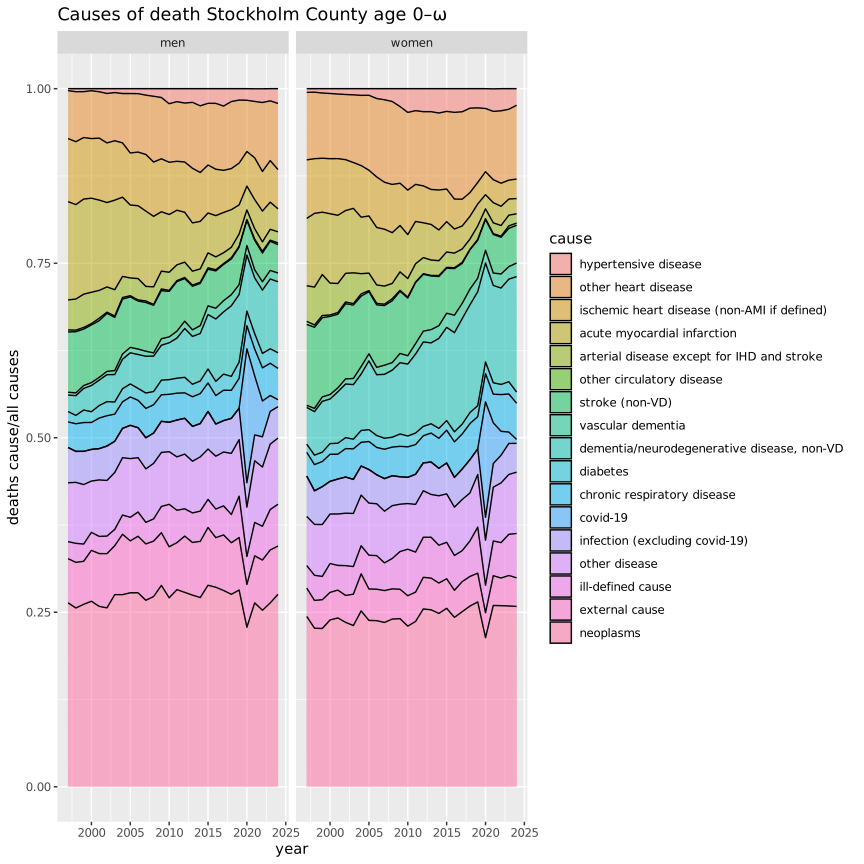
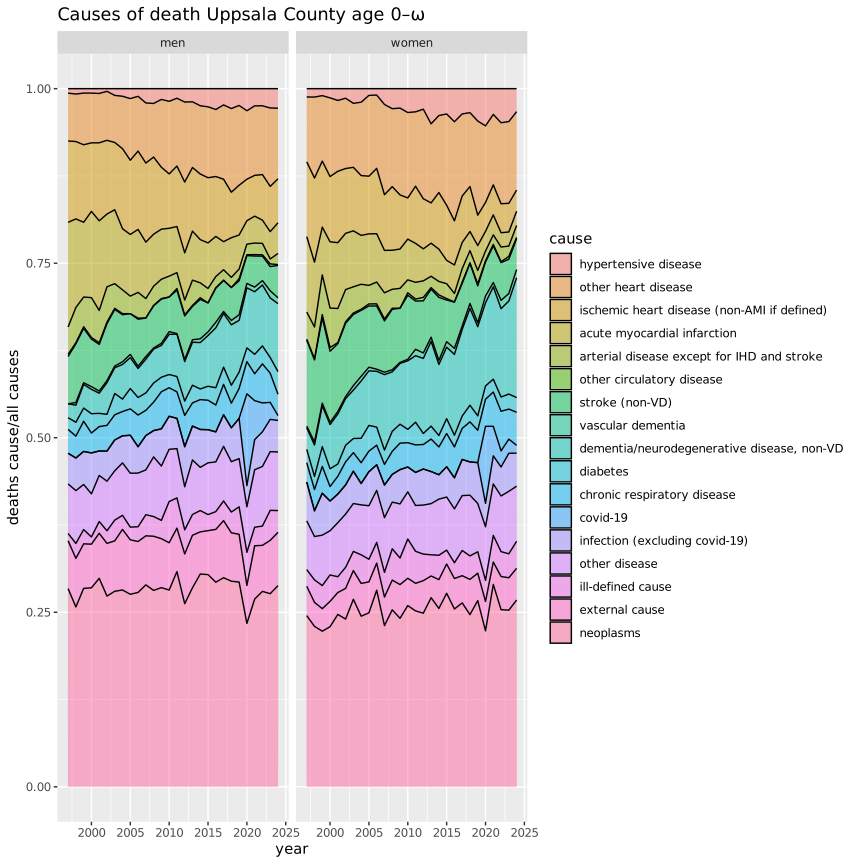
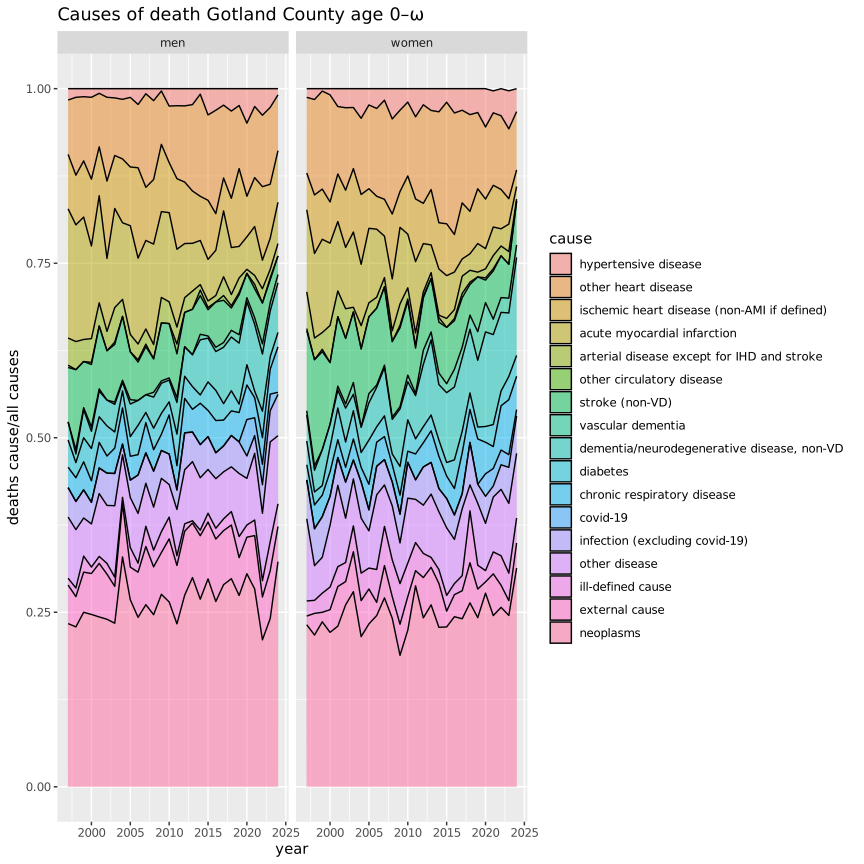
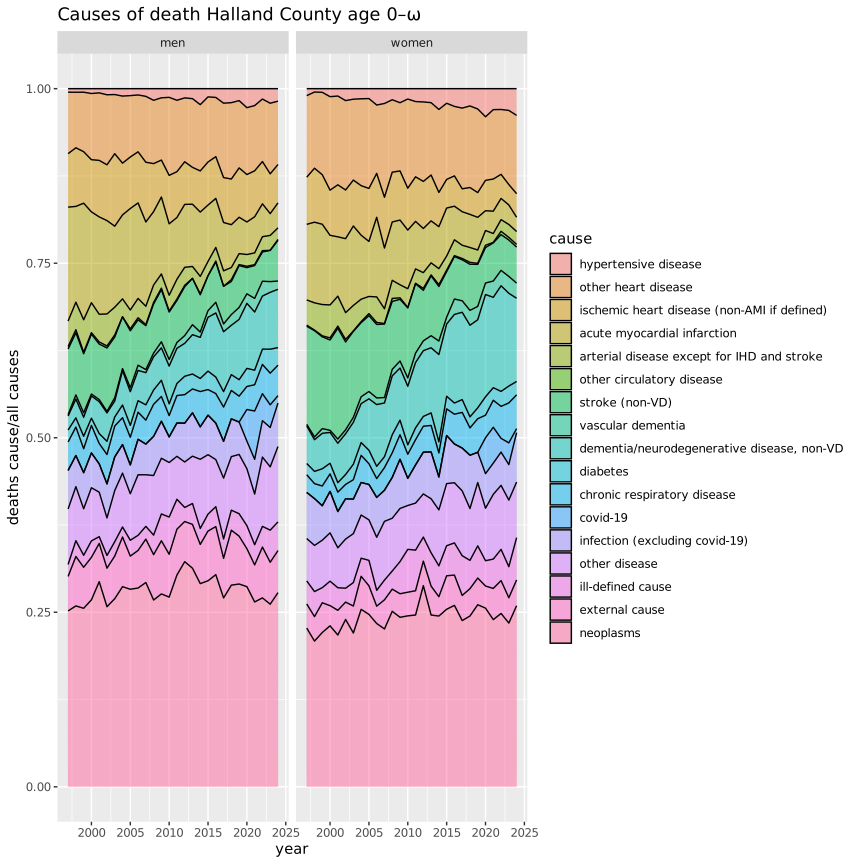
<p>With my <a href="https://github.com/klpn/morr">morr</a> R package, cause of death
patterns over time can be plotted using the data available via <span class="citation" data-cites="whomort">WHO (2025)</span>,
and also <span class="citation" data-cites="sosdoren">National Board of Health and Welfare (2025)</span>, for regional Swedish data, starting with 1997,
i.e. the first year ICD-10 was used. Made with the functions from the
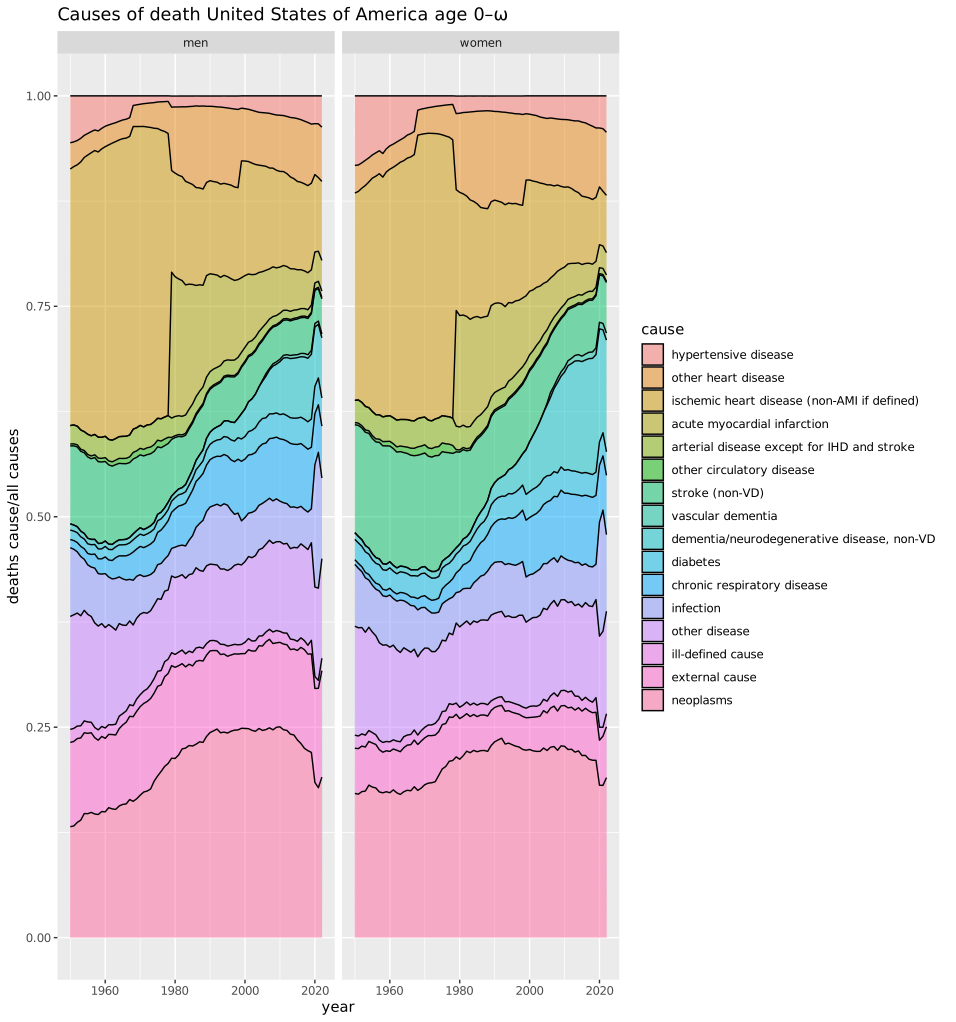
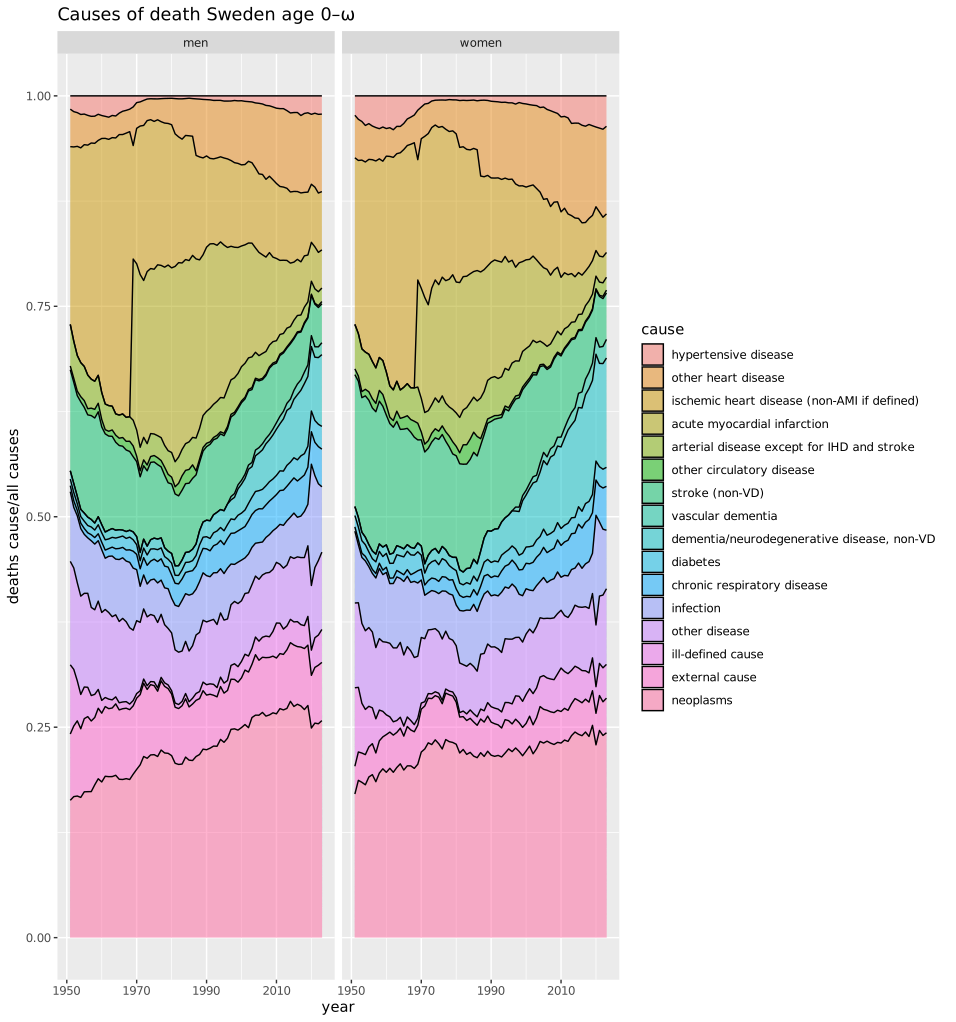
morr package, fig. 1, fig. 2, fig. 3 and fig. 4 show sex-specific cause
of death patterns for all ages for the four regions mentioned by
<span class="citation" data-cites="nilsson250919">Nilsson (2025)</span>.<a href="#fn1" class="footnote-ref" id="fnref1" role="doc-noteref"><sup>1</sup></a></p>
<figure id="fig:cpall_SE110a1">
<img src="../../images/cpall_SE110a1.svg" style="width:100.0%" alt="Figure 1: Cause of death pattern Stockholm." />
<figcaption aria-hidden="true">Figure 1: Cause of death pattern
Stockholm.</figcaption>
</figure>
<figure id="fig:cpall_SE121a1">
<img src="../../images/cpall_SE121a1.svg" style="width:100.0%" alt="Figure 2: Cause of death pattern Uppsala." />
<figcaption aria-hidden="true">Figure 2: Cause of death pattern
Uppsala.</figcaption>
</figure>
<figure id="fig:cpall_SE214a1">
<img src="../../images/cpall_SE214a1.svg" style="width:100.0%" alt="Figure 3: Cause of death pattern Gotland." />
<figcaption aria-hidden="true">Figure 3: Cause of death pattern
Gotland.</figcaption>
</figure>
<figure id="fig:cpall_SE231a1">
<img src="../../images/cpall_SE231a1.svg" style="width:100.0%" alt="Figure 4: Cause of death pattern Halland." />
<figcaption aria-hidden="true">Figure 4: Cause of death pattern
Halland.</figcaption>
</figure>
<p>As the figures show, the patterns are somewhat unstable from year to
year, especially in Gotland, with its small population. But the overall
pattern is clear: diseases in the circulatory chapter, i.e. the cause
categories down to and including stroke (excluding vascular dementia),
are getting less common, and their ratio to neoplasms has decreased, and
was in 2024 lower than 1 for at least one sex in all four regions. But
the neoplasm category itself has been rather stable when it comes to its
share of all deaths. It is not even hard to find earlier years with
somewhat higher share of neoplasm deaths for the sex- and
country-combinations with a circulation/neoplasm ratio lower than 1 in
2024.</p>
<ul>
<li>In Stockholm, some neoplasm was underlying cause in 25.8/27.6 percent
of all deaths among women/men in 2024. That share was highest among
women in 2019 (26.5 percent), and among men in 2015 (28.9 percent).
Already in 2005, the share was higher among men than in 2024 (27.8
percent).</li>
<li>In Uppsala, some neoplasm was underlying cause in 26.8/28.8 percent of
all deaths among women/men in 2024. That share was highest among women
in 2021 (29.0 percent), and among men in 2011 (30.8 percent). Already
in 2003, the share was higher among women than in 2024 (26.9 percent),
and in 2001, it was higher among men than in 2024 (29.9 percent).</li>
<li>In Gotland, some neoplasm was underlying cause in 31.3/32.2 percent of
all deaths among women/men in 2024. That share was highest among men
in 2004 (32.9 percent).</li>
<li>In Halland, some neoplasm was underlying cause in 25.9/27.8 percent of
all deaths among women/men in 2024. That share was highest among women
in 2012 (28.8 percent), and among men also in 2012 (32.2 percent).
Already in 2001, the share was higher among men than in 2024 (29.4
percent).</li>
</ul>
<p>In my <a href="2025-07-04-attack.html">4 July post</a>, I described the overall
changes in cause of death pattern in Sweden and other countries for a
longer period of time, and the trends in Sweden as a whole during the
ICD-10 period are, of course, also reflected on the regional level.
Myocardial infarction has decreased rapidly, but there has been little
change in other heart diseases, taken as a group. Stroke and arterial
diseases except for ischemic heart disease and stroke (including
generalized atherosclerosis) have also decreased a lot, mirroring a
marked increase in dementia, which is not included in the circulatory
chapter in ICD-10, even when specified as vascular. And covid-19, of
course, disturbed the cause pattern when it arrived in 2020,
particularly in Stockholm, where much of the spring wave was
concentrated, but has more recently diminished in importance with
increasing immunity in the population.</p>
<p>One thing that seems clear is that it is not informative to treat cause
of death patterns as elections in single-member districts, where getting
to number one is what matters, regardless of other aspects of the
distribution of votes.</p>
<h2 class="unnumbered" id="references">References</h2>
<div id="refs" class="references csl-bib-body hanging-indent" data-entry-spacing="0" role="list">
<div id="ref-sosdoren" class="csl-entry" role="listitem">
National Board of Health and Welfare. 2025. <span>“Cause of death.”</span> <a href="https://sdb.socialstyrelsen.se/if_dor/val_eng.aspx">https://sdb.socialstyrelsen.se/if_dor/val_eng.aspx</a>.
</div>
<div id="ref-nilsson250919" class="csl-entry" role="listitem">
Nilsson, Johan. 2025. <span>“Cancer allt vanligare dödsorsak.”</span> <em>DN</em> (19 September). <a href="https://www.dn.se/sverige/cancer-allt-vanligare-dodsorsak/">https://www.dn.se/sverige/cancer-allt-vanligare-dodsorsak/</a>.
</div>
<div id="ref-whomort" class="csl-entry" role="listitem">
WHO. 2025. <span>“WHO <span>M</span>ortality <span>D</span>atabase.”</span> <a href="https://www.who.int/data/data-collection-tools/who-mortality-database">https://www.who.int/data/data-collection-tools/who-mortality-database</a>.
</div>
</div>
<section id="footnotes" class="footnotes footnotes-end-of-document" role="doc-endnotes">
<hr />
<ol>
<li id="fn1"><p>The figures may be reproduced in R by cloning <a href="https://github.com/klpn/static-dust.git">the blog
repository</a> and running
<code>2025-09-28-one.r</code> in the subdirectory <code>postdata/2025-09-28-one</code>.
The causes are listed in the <code>capat</code> vector in that file, using the
cause definitions with ICD codes from the morr configuration file.<a href="#fnref1" class="footnote-back" role="doc-backlink">↩︎</a></p></li>
</ol>
</section>


]]></summary>
</entry>
<entry>
    <title>After the attacks</title>
    <link href="https://www.dusty-test.klpn.se/posts/2025-07-04-attack.html" />
    <id>https://www.dusty-test.klpn.se/posts/2025-07-04-attack.html</id>
    <published>2025-07-04T00:00:00Z</published>
    <updated>2025-07-04T00:00:00Z</updated>
    <summary type="html"><![CDATA[<h1>After the attacks</h1>
<div class="info">
	Posted on 2025-07-04
	
	by Karl Pettersson.
        
	
	Tags: <a title="All pages tagged &#39;epidemiology&#39;." href="/tags/epidemiology.html" rel="tag">epidemiology</a>
        
</div>

<p>Last week, a newly published article about trends in US heart disease
mortality <span class="citation" data-cites="King2025">(King et al. 2025)</span> got some attention in social media. The article
describes changed mortality patterns during the period 1970–2022: at
the beginning of the period, heart disease mortality was dominated by
ischemic heart disease (IHD), above all acute myocardial infarction
(AMI). During the half-century, there has been a large decrease in
overall heart disease mortality, but the decrease has been largest for
AMI, so that the mortality pattern now is dominated by other types of
heart disease, e.g. chronic IHD, hypertensive heart disease, and
functional heart conditions, e.g. heart failure and arrhythmia. It is
important to note that we are talking about underlying causes of death,
which can be added because exactly one is registered for each death, and
not cases where e.g. heart failure is reported as a complication of AMI.</p>
<p>I have written in my earlier Swedish blogs about similar patterns for
Sweden, e.g. on <a href="https://diversepedanteri.blogspot.com/2011/12/en-blir-tva.html">2 December
2011</a>.
With my <a href="https://github.com/klpn/morr">morr</a> R package, cause of death
patterns over time can be plotted using the data available via <span class="citation" data-cites="whomort">WHO (2025)</span>.
Unfortunately, these data cannot distinguish between AMI and other kinds
of IHD for ICD versions before ICD-9, which the first countries,
e.g. US, started using in 1979, and Sweden in 1987. That distinction is
not possible even with recent data based on ICD-10 for some countries
using the abridged List 1, e.g. Russia. Made with the functions from the
morr package, fig. 1 and fig. 2 show sex-specific cause of death
patterns for all ages for the US and Sweden.<a href="#fn1" class="footnote-ref" id="fnref1" role="doc-noteref"><sup>1</sup></a></p>
<figure id="fig:cpall2450a1">
<img src="../../images/cpall2450a1.svg" style="width:100.0%" alt="Figure 1: Cause of death pattern US." />
<figcaption aria-hidden="true">Figure 1: Cause of death pattern
US.</figcaption>
</figure>
<figure id="fig:cpall4290a1">
<img src="../../images/cpall4290a1.svg" style="width:100.0%" alt="Figure 2: Cause of death pattern Sweden." />
<figcaption aria-hidden="true">Figure 2: Cause of death pattern
Sweden.</figcaption>
</figure>
<p>The graphs show that the share of all deaths with heart disease as
underlying cause has decreased since the 1980s, both in Sweden and the
US, and that this largely has been driven by a large decrease in AMI.
Non-AMI heart disease has remained relatively constant, especially in
men, with some smaller variations, as with covid-19 entering the scene
as a competing cause in 2020. Within that group, there has also been
some drift from non-AMI IHD towards other heart disease (e.g. heart
failure) and hypertensive disease. It seems rather clear that much of
this is due to changed practices in certification, coding and selecting
underlying cause, e.g. the shift to ICD-9, which was accompanied by an
increase in other heart diseases, both in the US and Sweden. The
remarkably low share of deaths due to hypertensive disease in Sweden in
the early 1980s points to a strong tendency to attribute cardiac deaths,
where hypertension may have been involved, to IHD.</p>
<p>It is important to note that there will soon not be much room left for
further lowering the share of all deaths due to heart disease by
decreasing AMI mortality, because the share of heart disease deaths due
to AMI will be so small that further decrease will not make much
difference. And the decreasing share of AMI deaths may also have
consequences for the validity of using models based on older data for
population-level attribution of shares of IHD, or heart disease,
mortality to risk factors like cholesterol, which may largely influence
mortality through their effects on conditions closely related to AMI
<span class="citation" data-cites="medicina55100687">(Menotti and Puddu 2019)</span>.</p>
<p>For the overall decrease in the share of deaths due to circulatory
disease, as defined in ICD-8 to ICD-10, on which I made a quiz, as I
wrote about in my <a href="2024-12-09-quiz.html">9 December 2024 post</a>, the
decrease in cerebrovascular disease has also been significant. However,
I have plotted that group next to vascular dementia and other
dementia-related categories (including e.g. Alzheimer disease and
unspecified dementia). If one looks at these as a group, the changes
have not been that dramatic. And that would probably have been the
default way at looking at them, had cerebrovascular disease not been
moved from the chapter for neurological disease to circulatory disease
in ICD-8. With ICD-11, the category will be moved back, and it may again
seem natural to look at age-related neurological disease as a spectrum,
from more acute strokes over vascular dementia to mixed, Alzheimer or
unspecified dementia, similar to how the remains of the circulatory
chapter group AMI with chronic IHD, as well as functional and
hypertensive heart disease. One may also note that the group of arterial
disease except for IHD and stroke has decreased in parallel with the
increase in dementia. This group includes conditions like generalized
atherosclerois (ICD-10 I70.9), which may be regarded as <q>garbage codes</q>,
when used for underlying causes of death <span class="citation" data-cites="Naghavi2010">(Naghavi et al. 2010)</span>, and may in the
past often have been used in patients with dementia without other
obvious causes of death.</p>
<p>As noted in my December post, there are still countries with more than
50 percent of deaths due to circulatory disease, and many of these are
former Eastern Bloc countries. However, we should not, in that context,
regard these as simply present-day versions of Northern European and
Anglosphere high-AMI countries during late 20th Century. As I noted in
my <a href="2022-07-19-ihme.html">19 July 2022 post</a>, their life expectancy may
be as high as some Western countries like US in recent years, at least
among women. And the pattern within the circulatory categories may also
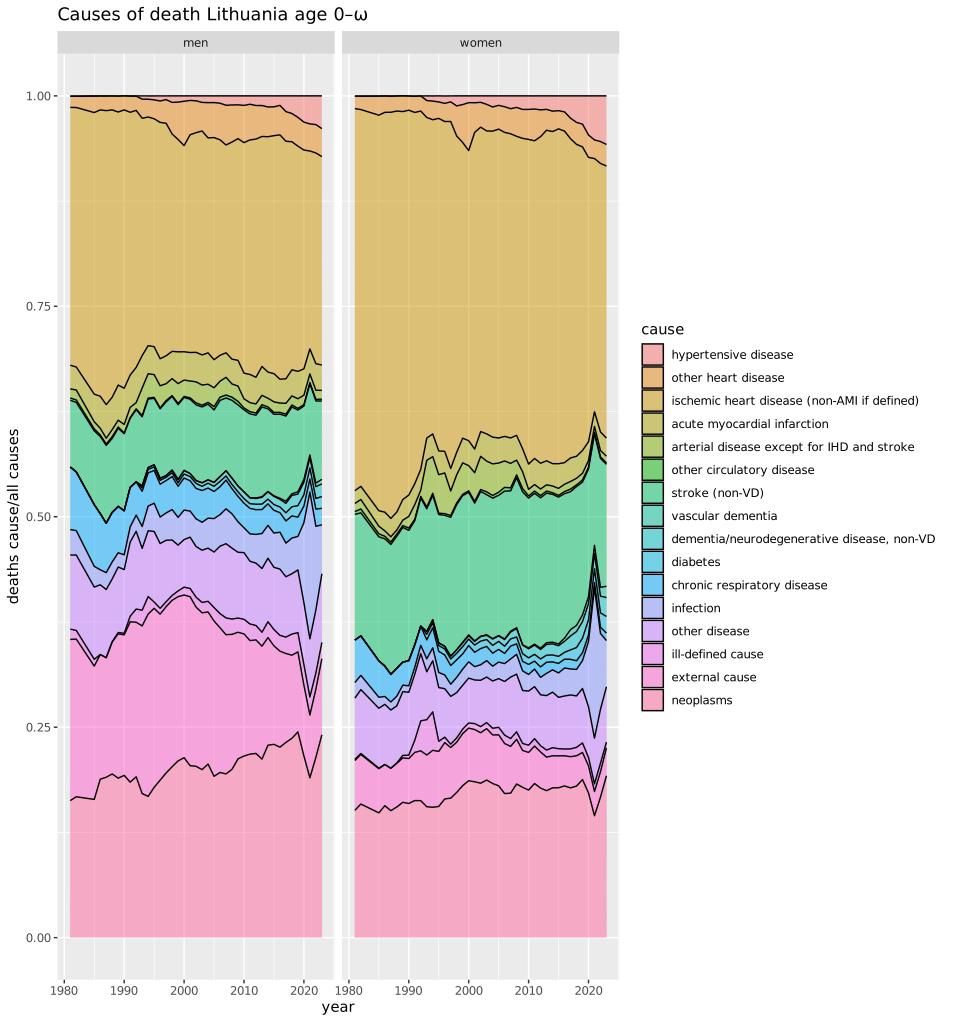
be very different from the older Western pattern. As an example, fig. 3,
shows the cause distribution for Lithuania, for the same categories as
in fig. 1 and fig. 2.</p>
<figure id="fig:cpall4188a1">
<img src="../../images/cpall4188a1.svg" style="width:100.0%" alt="Figure 3: Cause of death pattern Lithuania." />
<figcaption aria-hidden="true">Figure 3: Cause of death pattern
Lithuania.</figcaption>
</figure>
<p>As can be seen, Lithuania has a low proportion of deaths due to
dementia, and a high proportion due to circulatory disease, like the US
and Sweden 50 years ago. But there are also striking differences, with
the IHD category being larger among women than among men in Lithuania,
and AMI only consisting a small fraction of IHD, regardless of time
period. This is in line with the findings by <span class="citation" data-cites="Timonin2021">Timonin et al. (2021)</span>, discussing
differences in ascribing IHD deaths to AMI between Norway and Russia
(using detailed Russian data not available via <span class="citation" data-cites="whomort">WHO (2025)</span>, as noted
above). It remains to be seen whether future development, e.g. the
adoption of ICD-11, will lead to greater convergence between Western and
Eastern countries regarding these patterns.</p>
<h2 class="unnumbered" id="references">References</h2>
<div id="refs" class="references csl-bib-body hanging-indent" data-entry-spacing="0" role="list">
<div id="ref-King2025" class="csl-entry" role="listitem">
King, Sara J., Tenzin Yeshi Wangdak Yuthok, Adrian M. Bacong, Abha Khandelwal, Dhruv S. Kazi, Michael E. Mussolino, Sally S. Wong, et al. 2025. <span>“Heart disease mortality in the united states, 1970 to 2022.”</span> <em>Journal of the American Heart Association</em> 14 (13): e038644. doi:<a href="https://doi.org/10.1161/JAHA.124.038644">10.1161/JAHA.124.038644</a>.
</div>
<div id="ref-medicina55100687" class="csl-entry" role="listitem">
Menotti, Alessandro and Paolo Emilio Puddu. 2019. <span>“Epidemiology of heart disease of uncertain etiology: A population study and review of the problem.”</span> <em>Medicina</em> 55 (10). doi:<a href="https://doi.org/10.3390/medicina55100687">10.3390/medicina55100687</a>.
</div>
<div id="ref-Naghavi2010" class="csl-entry" role="listitem">
Naghavi, Mohsen, Susanna Makela, Kyle Foreman, Janaki O’Brien, Farshad Pourmalek and Rafael Lozano. 2010. <span>“Algorithms for enhancing public health utility of national causes-of-death data.”</span> <em>Population Health Metrics</em> 8 (1): 9. doi:<a href="https://doi.org/10.1186/1478-7954-8-9">10.1186/1478-7954-8-9</a>.
</div>
<div id="ref-scbdor1196" class="csl-entry" role="listitem">
SCB. 2019. <span>“Dödsorsaker (SOS) 1911–1996.”</span> <a href="https://www.scb.se/hitta-statistik/aldre-statistik/innehall/sveriges-officiella-statistik-sos/halso--och-sjukvard-19111996/dodsorsaker_sos_1911-1996/">https://www.scb.se/hitta-statistik/aldre-statistik/innehall/sveriges-officiella-statistik-sos/halso--och-sjukvard-19111996/dodsorsaker_sos_1911-1996/</a>.
</div>
<div id="ref-Timonin2021" class="csl-entry" role="listitem">
Timonin, Sergey, Vladimir M Shkolnikov, Evgeny Andreev, Per Magnus and David A Leon. 2021. <span>“<span class="nocase">Evidence of large systematic differences between countries in assigning ischaemic heart disease deaths to myocardial infarction: the contrasting examples of Russia and Norway</span>.”</span> <em>International Journal of Epidemiology</em> 50 (6): 2082–2090. doi:<a href="https://doi.org/10.1093/ije/dyab188">10.1093/ije/dyab188</a>.
</div>
<div id="ref-whomort" class="csl-entry" role="listitem">
WHO. 2025. <span>“WHO <span>M</span>ortality <span>D</span>atabase.”</span> <a href="https://www.who.int/data/data-collection-tools/who-mortality-database">https://www.who.int/data/data-collection-tools/who-mortality-database</a>.
</div>
</div>
<section id="footnotes" class="footnotes footnotes-end-of-document" role="doc-endnotes">
<hr />
<ol>
<li id="fn1"><p>The figures may be reproduced in R by cloning <a href="https://github.com/klpn/static-dust.git">the blog
repository</a> and running
<code>2025-07-04-attack.r</code> in the subdirectory
<code>postdata/2025-07-04-attack</code>. The causes are listed in the <code>capat</code>
vector in that file, using the cause definitions with ICD codes from
the morr configuration file. For Sweden, the AMI data for the ICD
period (1969–86) have been entered manually from PDF reports
available via <span class="citation" data-cites="scbdor1196">SCB (2019)</span>, and may thus contain transcription
errors. To use these with morr (only for all ages), you have to copy
the files <code>ami-all-4290.csv</code> and <code>ihdnoami-all-4290.csv</code> from
<code>postdata/2025-07-04-attack/data</code> to the <code>inst/extdata</code> directory
for morr.<a href="#fnref1" class="footnote-back" role="doc-backlink">↩︎</a></p></li>
</ol>
</section>


]]></summary>
</entry>
<entry>
    <title>Viral fireworks</title>
    <link href="https://www.dusty-test.klpn.se/posts/2025-01-03-fire.html" />
    <id>https://www.dusty-test.klpn.se/posts/2025-01-03-fire.html</id>
    <published>2025-01-03T00:00:00Z</published>
    <updated>2025-01-03T00:00:00Z</updated>
    <summary type="html"><![CDATA[<h1>Viral fireworks</h1>
<div class="info">
	Posted on 2025-01-03
	
	by Karl Pettersson.
        
	
	Tags: <a title="All pages tagged &#39;epidemiology&#39;." href="/tags/epidemiology.html" rel="tag">epidemiology</a>
        
</div>

<p>Around New Year, the Swedish newspaper DN had an article about the
spread of contagious diseases, like influenza and covid-19
<span class="citation" data-cites="letmark241231">(Letmark 2024)</span>. According to the article, the viruses are <q>spreading
rapidly</q> because we have lots of contacts around Christmas and New Year.
Sweden has indeed had to influenza seasons in a row with reporting cases
peaking in last week of the year. At the same time, one must remember
that this is due to gradual build-up of infections the weeks leading up
to Christmas, when people have lots of contacts at schools and
workplaces. If cases peak around New Year, this implies that <span class="math inline">\(\r\)</span> is on
its way down. As the article also states, the spread often increases
after start of spring semester, but if a lot of immunity has been built
up, we may avoid later peaks.</p>
<p>In my Swedish <a href="2024-11-25-vag.html">25 November post</a>, I wrote about
infectious disease trends in Sweden during fall, with covid-19 on a
plateau, <em>Mycoplasma pnemumoniae</em> infections at high levels, and flu
still at low levels. Updated reports around the holidays are sparse, but
data up until week 52 are available for Stockholm <span class="citation" data-cites="kulluftv5224">(Karolinska Universitetslaboratoriet 2025)</span>. Not
much has happened with covid-19, and <em>M. pnemumoniae</em> infections are now
on their way down. Influenza A has increased during December, but is
still at lower levels than during the December months 2021–23, and the
increase has stalled during week 52. As noted, we have yet to see
whether there will be large increases after the holidays.</p>
<p>An important reason for the early influenza peeks during 2021–23 is
most certainly that population immunity has been lower than usual,
because influenza almost stopped circulating during the pandemic. Now,
when we have had both A(H1N1)pdm09, A(H3N2) and B/Victoria circulating
after 2021, we may see a return to a pattern with influenza peaking
after New Year. Such a pattern for influenza peaks has been most common
in Sweden for several decades, or more. In my Swedish <a href="2020-06-22-normal.html">22 June 2020
post</a>, using data back to 1981, I noted that
peaks in total mortality already in December has coincided with severe
waves of seasonal influenza, as in 1988 and 1993.</p>
<p>On one of my old blogs, I wrote a Swedish post <a href="https://diversepedanteri.blogspot.com/2011/01/treklover.html">20 January
2011</a>
about cause-specific mortality in Sweden per month, for the years
1969–86, when ICD-8 was used and monthly statistics on underlying
causes of death in Sweden were included in published reports, later made
available via <span class="citation" data-cites="scbdor1196">SCB (2019)</span>. For the ICD-10 years, 1997 and onwards, such
statistics has recently been made available via <span class="citation" data-cites="sosdormanaden">National Board of Health and Welfare (2024)</span>. For the
ICD-8 period, the monthly statistics is available for all ages, and ages
above 75, but for the ICD-10 period, only statistics for all ages is
currently published.</p>
<p>In the monthly ICD-8 statistics, important categories for respiratory
infections include <q>acute respiratory infections and influenza</q> (ICD-8
460–478) and <q>pneumonia</q> (ICD-8 480–486), while the newer statistics
uses the block <q>influenza and pneumonia</q> (ICD-10 J09–J18), where the
use of the <q>and</q> conjunction often causes confusion, both in Swedish<a href="#fn1" class="footnote-ref" id="fnref1" role="doc-noteref"><sup>1</sup></a>
and English as it might be interpreted as referring to having both
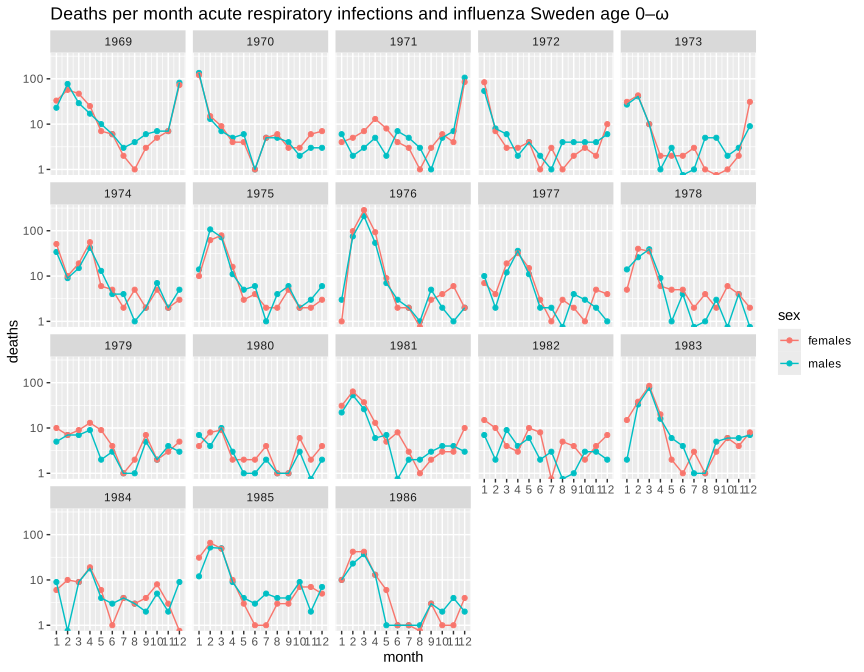
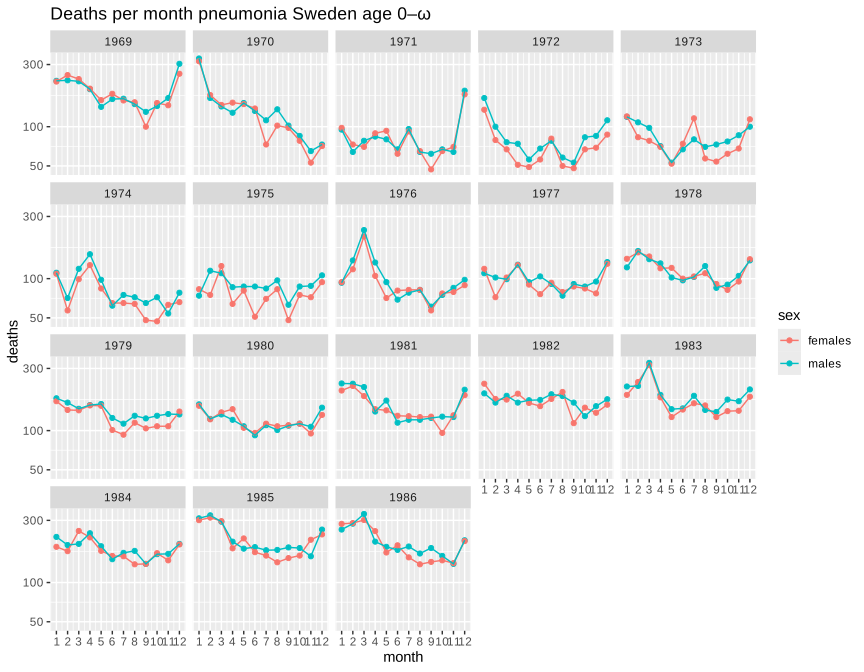
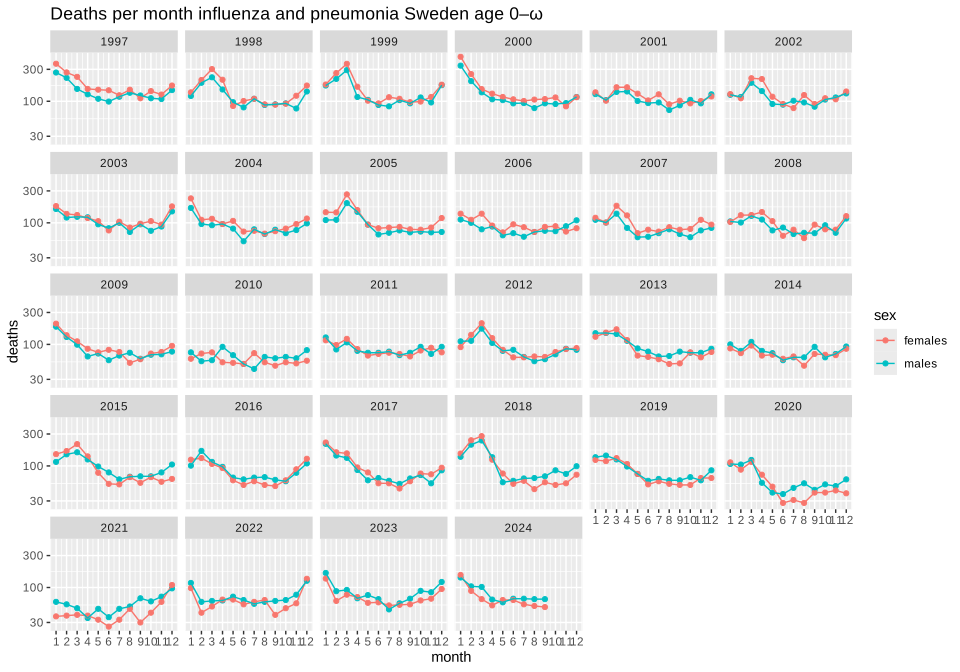
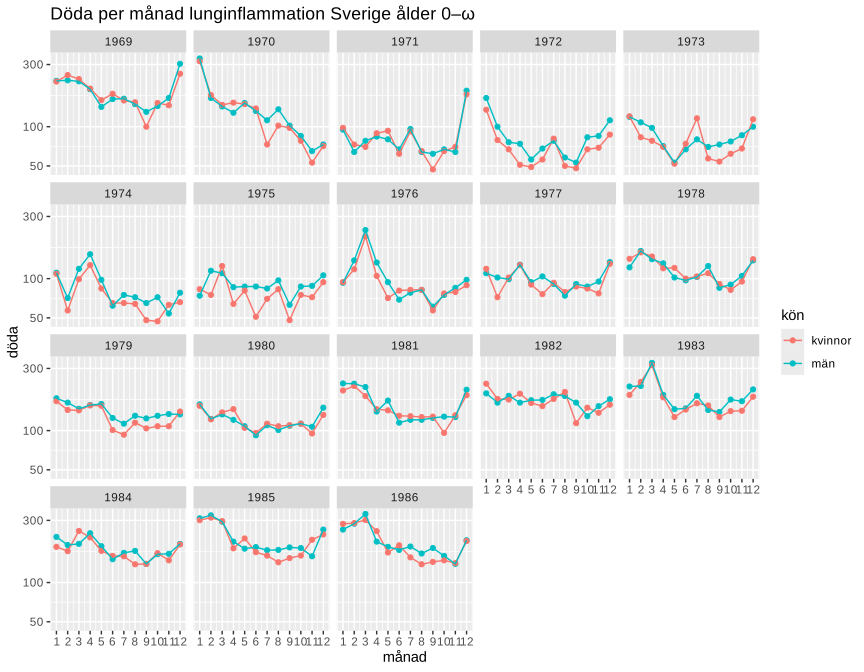
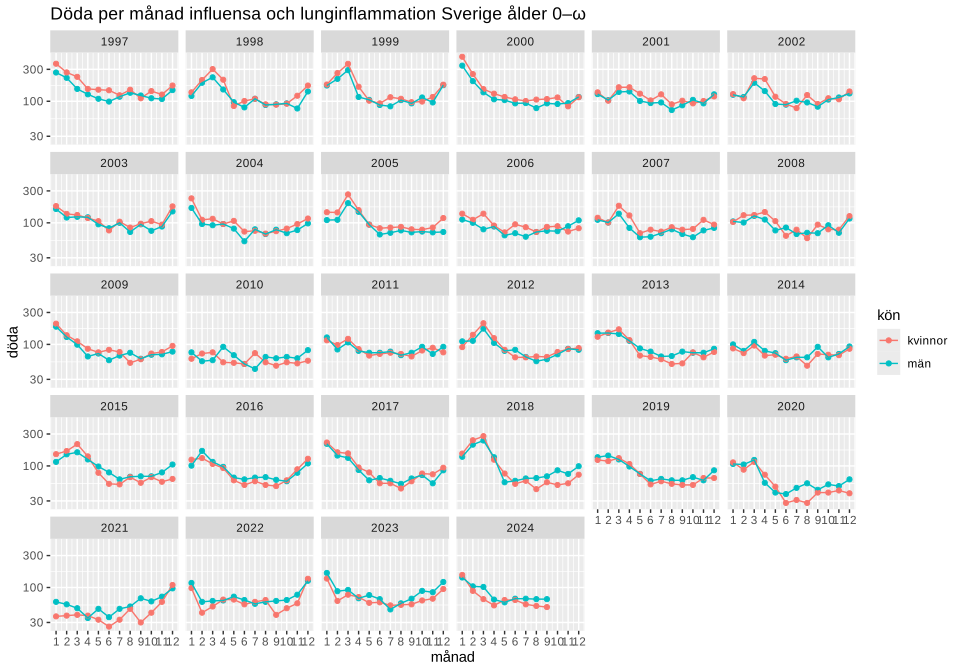
influenza and pneumonia, not (at least) one of the diseases. Fig. 1 and
fig. 2 show number of deaths among females and males in Sweden, all
ages, per month 1969–86, for the mentioned ICD-8 categories, and fig. 3
shows these data for influenza and pneumonia 1997–2024, with
preliminary data available up until September 2024.<a href="#fn2" class="footnote-ref" id="fnref2" role="doc-noteref"><sup>2</sup></a></p>
<figure id="fig:f27">
<img src="../../images/se_6986_f27_en.svg" style="width:100.0%" alt="Figure 1: Deaths by sex and month 1969–86 acute respiratory infections and influenza Sweden." />
<figcaption aria-hidden="true">Figure 1: Deaths by sex and month 1969–86 acute respiratory
infections and influenza
Sweden.</figcaption>
</figure>
<figure id="fig:f28">
<img src="../../images/se_6986_f28_en.svg" style="width:100.0%" alt="Figure 2: Deaths by sex and month 1969–86 pneumonia Sweden." />
<figcaption aria-hidden="true">Figure 2: Deaths by sex and month 1969–86 pneumonia
Sweden.</figcaption>
</figure>
<figure id="fig:j0918">
<img src="../../images/se_9724_j0918_en.svg" style="width:100.0%" alt="Figure 3: Deaths by sex and month 1997–2024 influenza and pneumonia Sweden." />
<figcaption aria-hidden="true">Figure 3: Deaths by sex and month 1997–2024 influenza and pneumonia
Sweden.</figcaption>
</figure>
<p>The graphs clearly show that mortality peaks already in December or
January have been relatively uncommon during both periods. In 1969, the
A(H3N2) pandemic peaked around New Year, and caused significant peaks in
both of the respiratory categories. After a calm 1970/71 season, there
was a new peak in late 1971, which perhaps may be seen as a second
pandemic wave in Sweden. Otherwise, there are no clear December peaks
during the 1969–86 period. The severe A(H3N2) seasons 1988/89 and
1993/94 occurred both during the ICD-9 period, for which no monthly
cause-specific statistics has been published yet, even though the excess
total mortality is clear, as noted above. For the ICD-10 period,
December and January peaks in the respiratory categories can be seen for
1999/2000, 2003/04, 2016/17, and the latest years, from 2021/22. Note
that the latest seasons are not large in size, compared to e.g. 2018.
Even though <q>immunity debt</q> after the decreased circulation in 2020–21
seems to have influenced the timing of the influenza seasons, they have
not necessarily been much larger than usual in terms of e.g. mortality.
In this respect, antigenic drift, relative to the strains people have
been exposed to earlier in life, may be more important than waning
immunity for influenza <span class="citation" data-cites="munro:hal-04731541">(Munro and House 2024)</span>.</p>
<p>One must remember that these respiratory captures by no means capture
all excess mortality caused by influenza. The smaller ICD-8 category,
<q>acute respiratory infections and influenza</q> is probably rather specific
for influenza-related mortality, but has low sensitivity. The categories
including pneumonia are probably neither very sensitive or specific. As
I noted in my 2011 post, much influenza-related mortality is ascribed to
circulatory causes, and in recent years probably often dementia. For
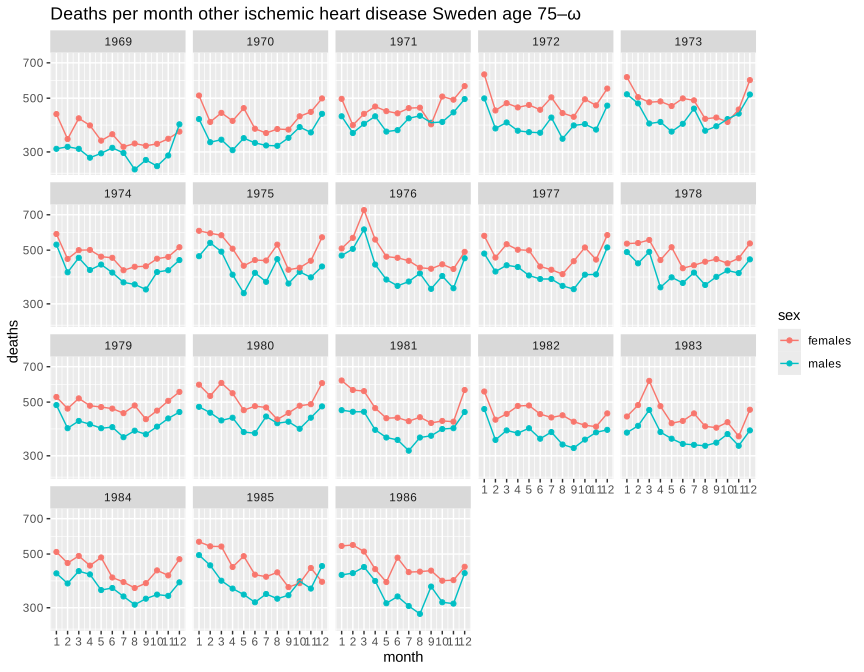
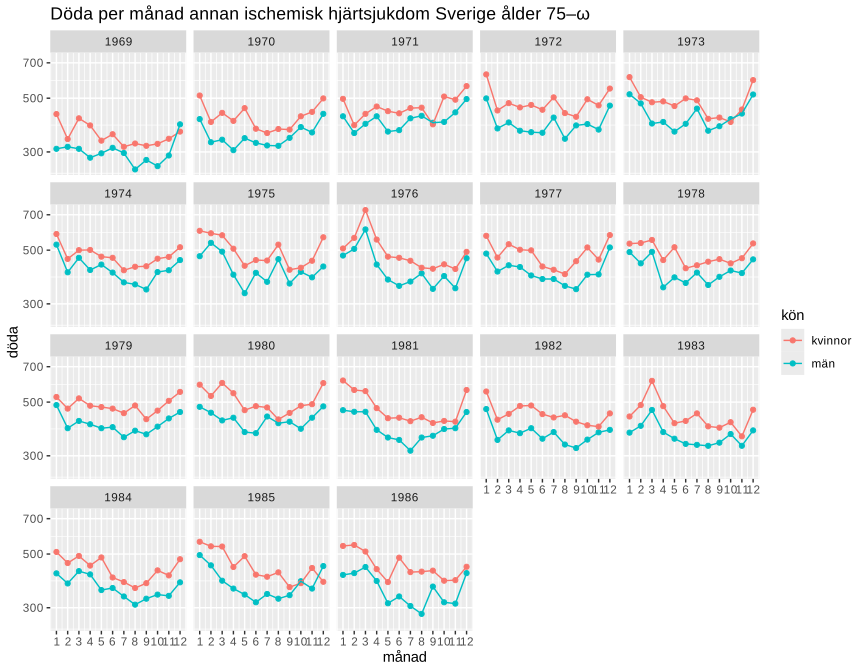
example, fig. 4 shows deaths among females and males in Sweden 1969–86
with <q>other ischemic heart disease</q> (ICD-8 411–414) as cause of death.</p>
<figure id="fig:f24_75">
<img src="../../images/se_6986_f24_75_en.svg" style="width:100.0%" alt="Figure 4: Deaths by sex and month 1969–86 other ischemic heart disease Sweden." />
<figcaption aria-hidden="true">Figure 4: Deaths by sex and month 1969–86 other ischemic heart
disease Sweden.</figcaption>
</figure>
<p>There are clear peaks in this type of mortality coinciding with, for
example, the flu peaks during March 1976 and March 1983. One may note
that the category is rather diffuse, and that many of these deaths in
recent years probably would have been ascribed to other causes, such as
dementia, in accordance with the trends I discussed in my <a href="2024-12-09-quiz.html">9 December
2024 post</a>.</p>
<p>For several seasons during the late 1970s and early 1980s, there is very
little excess mortality from influenza. This coincides with the
reintroduction of A(H1N1) 1977, where older generations were protected
by immunity they had acquired when this subtype circulated before 1957.
For similar reasons, they 2009 A(H1N1)pdm09 pandemic did not cause much
excess mortality either. There are also seasons dominated by influenza
B, with low average age among cases, and similarly low excess mortality.
One may take the 1983/84 as an example. During the winter, Moscow
reportedly had high influenza activity, mostly influenza B, and most
cases occurring among children and young adults <span class="citation" data-cites="cdcmmwr3310flu">(CDC 1984)</span>.
Eventually, the epidemic reached Sweden, and newspaper articles,
searchable via <span class="citation" data-cites="svdagstidn">Kungliga biblioteket (2024)</span>, indicate a peak in Stockholm in early April,
while mortality was at low levels.<a href="#fn3" class="footnote-ref" id="fnref3" role="doc-noteref"><sup>3</sup></a> In contrast, the relatively high
mortality during the possibly last B/Yamagata season, 2017/18, when
cases were much older on average, as I wrote in my Swedish <a href="2020-02-08-snall.html">8 February
2020 post</a>, shows that this depends on population
immunity, and not on influenza B being more benign by itself.</p>
<h2 class="unnumbered" id="references">References</h2>
<div id="refs" class="references csl-bib-body hanging-indent" data-entry-spacing="0" role="list">
<div id="ref-cdcmmwr3310flu" class="csl-entry" role="listitem">
CDC. 1984. <span>“Current trends influenza activity – mississippi, united states, worldwide.”</span> <em>MMWR</em> 33 (10) (16 March): 139–140. <a href="https://www.cdc.gov/mmwr/preview/mmwrhtml/00000300.htm">https://www.cdc.gov/mmwr/preview/mmwrhtml/00000300.htm</a>.
</div>
<div id="ref-kulluftv5224" class="csl-entry" role="listitem">
Karolinska Universitetslaboratoriet. 2025. <span>“Luftvägspatogener: Prov analyserade av karolinska universitetslaboratoriet till och med vecka 47 2024.”</span> <a href="https://www.karolinska.se/48cb6e/globalassets/global/2-funktioner/funktion-kul/klinisk-mikrobiologi/epidemiologi/rapport-influensa--och-rs-virus-och-andra-luftvagspatogener.pdf">https://www.karolinska.se/48cb6e/globalassets/global/2-funktioner/funktion-kul/klinisk-mikrobiologi/epidemiologi/rapport-influensa--och-rs-virus-och-andra-luftvagspatogener.pdf</a>.
</div>
<div id="ref-svdagstidn" class="csl-entry" role="listitem">
Kungliga biblioteket. 2024. <span>“Svenska tidningar.”</span> <a href="http://tidningar.kb.se/">http://tidningar.kb.se/</a>.
</div>
<div id="ref-letmark241231" class="csl-entry" role="listitem">
Letmark, Peter. 2024. <span>“Smittexperten: Stanna hemma i nyår om du är sjuk.”</span> <em>DN</em> (31 December). <a href="https://www.dn.se/sverige/smittexperten-stanna-hemma-i-nyar-om-du-ar-sjuk/">https://www.dn.se/sverige/smittexperten-stanna-hemma-i-nyar-om-du-ar-sjuk/</a>.
</div>
<div id="ref-munro:hal-04731541" class="csl-entry" role="listitem">
Munro, Alasdair P S and Thomas House. 2024. <span>“<span class="nocase">Cycles of susceptibility: Immunity debt explains altered infectious disease dynamics post-pandemic</span>.”</span> <em><span>Clinical Infectious Diseases</span></em>. <a href="https://hal.science/hal-04731541">https://hal.science/hal-04731541</a>.
</div>
<div id="ref-sosdormanaden" class="csl-entry" role="listitem">
National Board of Health and Welfare. 2024. <span>“Statistical database, cause of death.”</span> <a href="https://sdb.socialstyrelsen.se/if_dor_manad/val_eng.aspx">https://sdb.socialstyrelsen.se/if_dor_manad/val_eng.aspx</a>.
</div>
<div id="ref-scbdor1196" class="csl-entry" role="listitem">
SCB. 2019. <span>“Dödsorsaker (SOS) 1911–1996.”</span> <a href="https://www.scb.se/hitta-statistik/aldre-statistik/innehall/sveriges-officiella-statistik-sos/halso--och-sjukvard-19111996/dodsorsaker_sos_1911-1996/">https://www.scb.se/hitta-statistik/aldre-statistik/innehall/sveriges-officiella-statistik-sos/halso--och-sjukvard-19111996/dodsorsaker_sos_1911-1996/</a>.
</div>
</div>
<section id="footnotes" class="footnotes footnotes-end-of-document" role="doc-endnotes">
<hr />
<ol>
<li id="fn1"><p>I wrote about a Swedish example in my <a href="2020-03-14-enkel.html">14 March 2020
post</a>.<a href="#fnref1" class="footnote-back" role="doc-backlink">↩︎</a></p></li>
<li id="fn2"><p>The figures may be reproduced in R by cloning <a href="https://github.com/klpn/static-dust.git">the blog
repository</a> and running
<code>2025-01-03-fire.r</code> in the subdirectory <code>postdata/2025-01-03-fire</code>.
Note that the figures for 1969–86 are based on data in the PDF
reports and may contain transcription errors.<a href="#fnref2" class="footnote-back" role="doc-backlink">↩︎</a></p></li>
<li id="fn3"><p>Some may have caught it and recovered, only to succumb to more
sinister fates in early summer.<a href="#fnref3" class="footnote-back" role="doc-backlink">↩︎</a></p></li>
</ol>
</section>


]]></summary>
</entry>
<entry>
    <title>Virala fyrverkerier</title>
    <link href="https://www.dusty-test.klpn.se/posts/2025-01-02-fyr.html" />
    <id>https://www.dusty-test.klpn.se/posts/2025-01-02-fyr.html</id>
    <published>2025-01-02T00:00:00Z</published>
    <updated>2025-01-02T00:00:00Z</updated>
    <summary type="html"><![CDATA[<h1>Virala fyrverkerier</h1>
<div class="info">
	Postad 2025-01-02
	
	av Karl Pettersson.
        
	
	Taggar: <a title="All pages tagged &#39;epidemiologi&#39;." href="/tags/epidemiologi.html" rel="tag">epidemiologi</a>
        
</div>

<p>Nu till nyår hade DN en artikel om spridning av smittor som influensa
och covid-19 <span class="citation" data-cites="letmark241231">(Letmark 2024)</span>. Det påstår att virus sprids <q>med hög
fart</q>, därför att vi <q>träffas och umgås med varandra ganska tätt</q> vid
jul och nyår. Ja, vi har nu haft två influensasäsonger i rad där de
rapporterade fallen toppade just årets sista vecka. Men det är viktigt
att komma ihåg att detta beror på att smittan byggts upp veckorna innan,
när folk träffats på skolor och arbetsplatser. Om de rapporterade fallen
toppar kring nyår, innebär det att <span class="math inline">\(\r\)</span> är på väg ned. Som också påtalas
i artikeln tenderar smittspridningen sedan ofta att öka efter
vårterminens start, men om mycket immunitet hunnit byggas upp före nyår,
kan det hända att det inte blir någon senare topp.</p>
<p><a href="2024-11-25-vag.html">Den 25 november</a> skrev jag litet om utvecklingen
under hösten, där covid-19 hamnat på en platå, mykoplasma i luftvägarna
nått höga nivåer och influensan ännu inte tagit fart. Mycket av
rapporteringen ligger nu nere över helgerna, men data till och med vecka
52 finns tillgängliga för Stockholm <span class="citation" data-cites="kulluftv5224">(Karolinska Universitetslaboratoriet 2025)</span>. Det är fortsatt
mycket små förändringar när det gäller covid-19, och infektioner av <em>M.
pneumoniae</em> är definitivt på väg nedåt. Influensa A har ökat under
december, men den befinner sig på lägre nivåer än decembermånaderna
2021–23, och ökningen har bromsats upp vecka 52. Som sagt återstår att
se vad som händer när vårterminen börjar.</p>
<p>En viktig anledning till de tidiga influensatopparna de senaste åren är
säkerligen att immuniteten i befolkningen varit lägre än vanligt under
hösten efter att cirkulationen av influensa hållits nere under pandemin.
När nu både A(H1N1)pdm09, A(H3N2) och B/Victoria cirkulerat efter 2021,
kanske det innebär en återgång till ett mönster där influensan oftast
toppar efter nyår. Ett sådant mönster för influnesatopparna har varit
det vanliga i Sverige under lång tid. Som jag visade på <a href="2020-06-22-normal.html">den 22 juni
2020</a>, med data tillbaka till 1981, har
dödlighetstoppar redan i december sammanfallit med svåra
säsongsinfluensor, som 1988 och 1993.</p>
<p><a href="https://diversepedanteri.blogspot.com/2011/01/treklover.html">Den 20 januari
2011</a>
skrev jag på min då aktiva blogg om orsaksspecifik dödlighet i Sverige
per månad, för åren 1969–86, då ICD-8 användes och månadsstatistik över
underliggande dödsorsaker i Sverige publicerades, som sedan gjorts
tillgänglig via <span class="citation" data-cites="scbdor1196">SCB (2019)</span>. För perioden med ICD-10, från 1997 och
framåt, finns liknande statistik numera tillgänglig via <span class="citation" data-cites="sosdormanad">Socialstyrelsen (2024)</span>.
Statistiken för den äldre perioden finns publicerad för alla åldrar och
åldrar från 75 år, medan den för den nyare perioden endast finns för
alla åldrar.</p>
<p>För månadsstatistiken baserad på ICD-8 finns för luftvägsinfektioner
kategorierna <q>akuta luftvägsinfektioner och influensa</q> (ICD-8 460–478)
och <q>lunginflammation</q> (ICD-8 480–486), men för den nyare statistiken
finns den sammanslagna <q>influensa och lunginflammation</q> (ICD-10
J09–J18), en benämning som flera gånger gett upphov till förvirring,
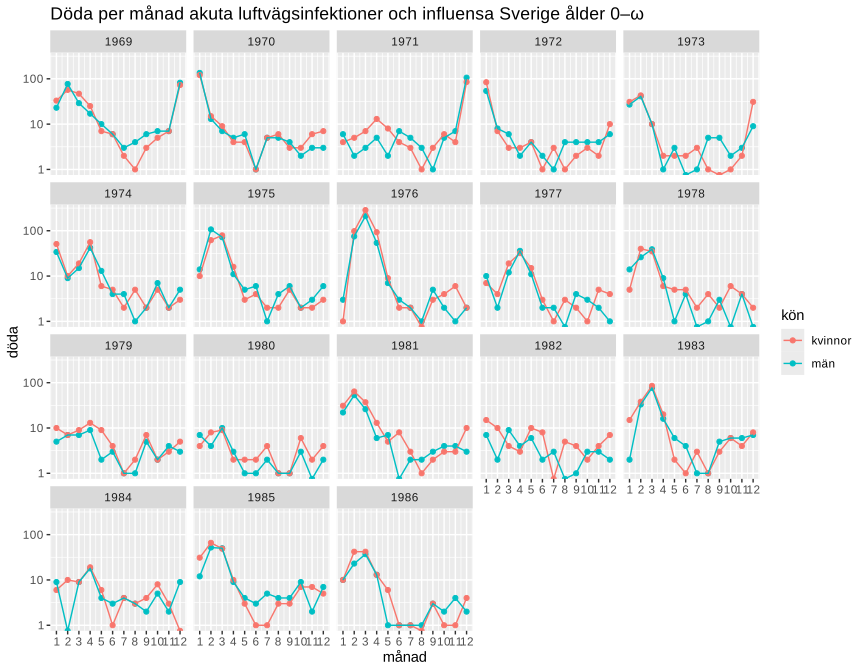
vilket jag skrev om <a href="2020-03-14-enkel.html">den 14 mars 2020</a>. Fig. 1
och fig. 2 visar döda kvinnor och män i Sverige per månad 1969–86 för
de nämnda luftvägskategorierna från ICD-8, och fig. 3 visar motsvarande
data för influensa och lunginflammation 1997–2024, med preliminär
statistik till september 2024.<a href="#fn1" class="footnote-ref" id="fnref1" role="doc-noteref"><sup>1</sup></a></p>
<figure id="fig:f27">
<img src="../../images/se_6986_f27.svg" style="width:100.0%" alt="Figur 1: Döda per kön och månad 1969–86 akuta luftvägsinfektioner och influensa Sverige." />
<figcaption aria-hidden="true">Figur 1: Döda per kön och månad 1969–86 akuta luftvägsinfektioner och
influensa Sverige.</figcaption>
</figure>
<figure id="fig:f28">
<img src="../../images/se_6986_f28.svg" style="width:100.0%" alt="Figur 2: Döda per kön och månad 1969–86 lunginflammation Sverige." />
<figcaption aria-hidden="true">Figur 2: Döda per kön och månad 1969–86 lunginflammation
Sverige.</figcaption>
</figure>
<figure id="fig:j0918">
<img src="../../images/se_9724_j0918.svg" style="width:100.0%" alt="Figur 3: Döda per kön och månad 1997–2024 influensa och lunginflammation Sverige." />
<figcaption aria-hidden="true">Figur 3: Döda per kön och månad 1997–2024 influensa och
lunginflammation Sverige.</figcaption>
</figure>
<p>Det är tydligt att dödlighetstoppar redan i december eller januari varit
ganska ovanliga under båda perioderna. År 1969 kom pandemin med A(H3N2),
och den toppade kring nyår, vilket syns på båda luftvägskategorierna.
Efter en lugn säsong 1970/71 blev det på nytt en topp i slutet av 1971,
som möjligen skulle kunna betecknas som en andra pandemivåg i Sverige. I
övrigt är det svårt att se några klara decembertoppar under hela
perioden. De svåra A(H3N2)-säsongerna 1988/89 och 1993/94 inträffade
alltså under perioden då månadsstatistik över dödsorsaker inte
publicerats, även om statistiken över total dödlighet talar sitt tydliga
språk, som jag visat på i tidigare inlägg. För perioden med ICD-10 går
det att se december- eller januaritoppar i influensa och
lunginflammation kring millennieskiftet, 2003/04, 2016/17, och de
senaste åren, från 2021/22.</p>
<p>En viktig sak är att dessa luftvägskategorier inte fångar upp all
överdödlighet relaterad till influensa. Den mindre kategorin baserad på
ICD-8 är troligen relativt specifik för influensa, men inte speciellt
sensitiv. Kategorierna för lunginflammation, eller <q>influensa och
lunginflammation</q> är varken speciellt sensitiva eller specifika. Som jag
visade på i mitt inlägg från 2011 är det en hel del influensarelaterad
dödlighet som tillskrivs hjärtsjukdomar, och på senare år säkerligen
demens. Som ett exempel visar fig. 4 nedan dödsfall bland kvinnor och
män 75 år och äldre i Sverige 1969–86 med <q>annan ischemisk
hjärtsjukdom</q> (ICD-8 411–414) som dödsorsak.</p>
<figure id="fig:f24_75">
<img src="../../images/se_6986_f24_75.svg" style="width:100.0%" alt="Figur 4: Döda per kön och månad 1969–86 annan ischemisk hjärtsjukdom Sverige." />
<figcaption aria-hidden="true">Figur 4: Döda per kön och månad 1969–86 annan ischemisk hjärtsjukdom
Sverige.</figcaption>
</figure>
<p>Här syns t.ex. tydliga toppar som sammanfaller med influensatopparna
marsmånaderna 1976 och 1983. Det kan noteras att detta också är en
ganska diffus kategori, där många dödsfall i dag troligen hade
tillskrivits t.ex. demens, i enlighet med de trender jag senast tog upp
i inlägget <a href="2024-12-09-quiz.html">den 9 december förra året</a>.</p>
<p>Det finns också flera säsonger under sent 1970-tal och tidigt 1980-tal
där det tycks ha varit mycket litet influensarelaterad dödlighet. Detta
sammanfaller med återintroduktionen av A(H1N1) 1977, där äldre
generationer skyddades av immunitet som de förvärvat när subtypen
cirkulerade före 1957. Av liknande skäl gav inte heller pandemin 2009,
med A(H1N1)pdm09 upphov till någon tydlig topp i dödlighet. Även
säsonger dominerade av influensa B, som också haft låg medelålder bland
fallen och medfört låg dödlighet, har förekommit. Ett exempel kan vara
1983/84. I mars 1984 rapporterades att det varit hög influensaktivitet i
Moskva, primärt kopplad till influensa B, och att de flesta drabbade var
barn och unga vuxna <span class="citation" data-cites="cdcmmwr3310flu">(CDC 1984)</span>. Den nådde tydligen också Sverige,
och artiklar som kan sökas via <span class="citation" data-cites="svdagstidn">Kungliga biblioteket (2024)</span> tyder på en topp i Stockholm
under första halvan av april, samtidigt som dödligheten alltså var på
låga nivåer.<a href="#fn2" class="footnote-ref" id="fnref2" role="doc-noteref"><sup>2</sup></a> De relativt höga dödstalen den kanske sista säsongen
med B/Yamagata 2017/18, när de drabbade var äldre, som jag skrev om <a href="2020-02-08-snall.html">den
8 februari 2020</a>, visar att detta beror på
immuniteten i befolkningen, och inte på att influensa B skulle vara
lindrigare i sig.</p>
<h2 class="unnumbered" id="referenser">Referenser</h2>
<div id="refs" class="references csl-bib-body hanging-indent" data-entry-spacing="0" role="list">
<div id="ref-cdcmmwr3310flu" class="csl-entry" role="listitem">
CDC. 1984. <span>”Current Trends Influenza Activity – Mississippi, United States, Worldwide”</span>. <em>MMWR</em> 33 (10) (16 mars): 139–140. <a href="https://www.cdc.gov/mmwr/preview/mmwrhtml/00000300.htm">https://www.cdc.gov/mmwr/preview/mmwrhtml/00000300.htm</a>.
</div>
<div id="ref-kulluftv5224" class="csl-entry" role="listitem">
Karolinska Universitetslaboratoriet. 2025. <span>”Luftvägspatogener: Prov analyserade av Karolinska Universitetslaboratoriet till och med vecka 47 2024”</span>. <a href="https://www.karolinska.se/48cb6e/globalassets/global/2-funktioner/funktion-kul/klinisk-mikrobiologi/epidemiologi/rapport-influensa--och-rs-virus-och-andra-luftvagspatogener.pdf">https://www.karolinska.se/48cb6e/globalassets/global/2-funktioner/funktion-kul/klinisk-mikrobiologi/epidemiologi/rapport-influensa--och-rs-virus-och-andra-luftvagspatogener.pdf</a>.
</div>
<div id="ref-svdagstidn" class="csl-entry" role="listitem">
Kungliga biblioteket. 2024. <span>”Svenska tidningar”</span>. <a href="http://tidningar.kb.se/">http://tidningar.kb.se/</a>.
</div>
<div id="ref-letmark241231" class="csl-entry" role="listitem">
Letmark, Peter. 2024. <span>”Smittexperten: Stanna hemma i nyår om du är sjuk”</span>. <em>DN</em> (31 december). <a href="https://www.dn.se/sverige/smittexperten-stanna-hemma-i-nyar-om-du-ar-sjuk/">https://www.dn.se/sverige/smittexperten-stanna-hemma-i-nyar-om-du-ar-sjuk/</a>.
</div>
<div id="ref-scbdor1196" class="csl-entry" role="listitem">
SCB. 2019. <span>”Dödsorsaker (SOS) 1911–1996”</span>. <a href="https://www.scb.se/hitta-statistik/aldre-statistik/innehall/sveriges-officiella-statistik-sos/halso--och-sjukvard-19111996/dodsorsaker_sos_1911-1996/">https://www.scb.se/hitta-statistik/aldre-statistik/innehall/sveriges-officiella-statistik-sos/halso--och-sjukvard-19111996/dodsorsaker_sos_1911-1996/</a>.
</div>
<div id="ref-sosdormanad" class="csl-entry" role="listitem">
Socialstyrelsen. 2024. <span>”Statistikdatabas för dödsorsaker”</span>. <a href="https://sdb.socialstyrelsen.se/if_dor_manad/val.aspx">https://sdb.socialstyrelsen.se/if_dor_manad/val.aspx</a>.
</div>
</div>
<section id="footnotes" class="footnotes footnotes-end-of-document" role="doc-endnotes">
<hr />
<ol>
<li id="fn1"><p>Figurerna kan återskaps med R genom att klona
<a href="https://github.com/klpn/static-dust.git">bloggförrådet</a> och köra
<code>2025-01-02-fyr.r</code> i underkatalogen <code>postdata/2025-01-02-fyr</code>. För
statistiken för 1969–86 reserverar jag mig för transkriptionsfel.<a href="#fnref1" class="footnote-back" role="doc-backlink">↩︎</a></p></li>
<li id="fn2"><p>Vissa kan ha fått den och tillfrisknat, för att sedan råka ut för
dystrare öden framåt sommaren.<a href="#fnref2" class="footnote-back" role="doc-backlink">↩︎</a></p></li>
</ol>
</section>


]]></summary>
</entry>
<entry>
    <title>Circulatory clue</title>
    <link href="https://www.dusty-test.klpn.se/posts/2024-12-09-quiz.html" />
    <id>https://www.dusty-test.klpn.se/posts/2024-12-09-quiz.html</id>
    <published>2024-12-09T00:00:00Z</published>
    <updated>2024-12-09T00:00:00Z</updated>
    <summary type="html"><![CDATA[<h1>Circulatory clue</h1>
<div class="info">
	Posted on 2024-12-09
	
	by Karl Pettersson.
        
	
	Tags: <a title="All pages tagged &#39;epidemiology&#39;." href="/tags/epidemiology.html" rel="tag">epidemiology</a>
        
</div>

<p>On 26 November, i posted a little quiz on Bluesky, with screenshots of
Visidata <span class="citation" data-cites="visidata">(Pwanson 2024)</span> showing year intervals during which a certain
epidemiological property held for female and male populations
<span class="citation" data-cites="kpbsky241126">(Pettersson 2024)</span>. The tables are also available on this site, as
tab-delimited files for <a href="../prop_x_f.txt">female</a> and
<a href="../prop_x_m.txt">male</a> populations. I asked about the property they
show.</p>
<p>The answer is that they show the first and last, or latest, year, and
total number of years, with mortality statistics available via <span class="citation" data-cites="whomort">WHO (2025)</span>,
for which at least 50 percent of deaths among females or males, over all
ages, have circulatory disease as underlying cause of death. To avoid
fluctuations caused by small populations, in microstates and other
territories in the WHO statistics, only years with at least 200 total
deaths for each sex have been included.</p>
<p>Circulatory deaths are defined according to the expressions in the
<a href="https://github.com/klpn/MortIntl.jl/blob/a696fb1e9ab72bc7f89d5bd13a9cb3286bbae546/data/mortintl.json#L163">Mortintl.jl
counfiguration</a>,
i.e. mostly the circulatory chapter in the different ICD versions, plus
cerebrovascular diseases, which were included in the neurological
chapter in ICD-6/7, as they will be again in ICD-11 <span class="citation" data-cites="icd11mms">(WHO 2024)</span>.</p>
<p>The tables show patterns similar to the ones I discussed earlier, e.g.
in my posts <a href="2022-03-27-transition.html">27 March 2022</a> and <a href="2022-07-19-ihme.html">19 July
2022</a>. In general, having at least 50 percent
deaths ascribed to circulatory disease, has been more common among
females, despite females having lower risk for early circulatory death
than males in most populations.</p>
<p>The earliest statistics available via <span class="citation" data-cites="whomort">WHO (2025)</span> is from 1950, and at that
time, populations in the Anglosphere, such as US, Australia, New
Zealand, England and Wales and Scotland, had the property for at least
their female populations, and Nordic countries soon followed. However,
in most of these countries, the period ended in the 1980s. Sweden was
relatively late, with 1991 and 1994 as last years for males and females.
The last European non ex-Communist countries having it for at least
their female populations were Austria and Germany (partially former East
Germany, however) in 2003, and Greece in 2008. Most of the countries
with end years later than 2000 are former Eastern Bloc countries in
Eastern Europe or Central Asia, and some Middle East and North African
countries, such as Syria and Egypt. It should be noted that the
availability of statistics via <span class="citation" data-cites="whomort">WHO (2025)</span> is very sparse for many
countries, especially in Africa.</p>
<p>These developments could be interpreted partially as a story of rising
and falling mortality from circulatory diseases, due to medical advances
and environmental factors. But, as I have touched on in my earlier
posts, they probably, above all, tell us a story about changing views of
what we accept as causes of death, as discussed by <span class="citation" data-cites="reid241114">Reid (2024)</span>. Rich
countries in the Anglosphere were quick to largely dismiss causes like
<q>old age</q> during the 20th Century, which led to circulatory diseases,
often referring to arteriosclerosis, dominating age-related mortality
instead <span class="citation" data-cites="Kohn82">(Kohn 1982)</span>. But later, these countries, with their ageing
populations, were also quick in perceiving also these practices as too
rough, which has led to increasing shares of deaths attributed to other
causes, such as dementia, and the, for the Western countries, typical
late 20th Century pattern, with a high proportion of circulatory deaths,
nowadays being most common in middle-income countries. The mentioned
changes in ICD-11, where stroke and other cerebrovascular diseases are
separated from heart disease and merged together with dementia, may be
seen in light of these changed perceptions.</p>
<h2 class="unnumbered" id="references">References</h2>
<div id="refs" class="references csl-bib-body hanging-indent" data-entry-spacing="0" role="list">
<div id="ref-Kohn82" class="csl-entry" role="listitem">
Kohn, Robert R. 1982. <span>“Cause of death in very old people.”</span> <em>JAMA</em> 247 (20): 2793–2797. doi:<a href="https://doi.org/10.1001/jama.1982.03320450027027">10.1001/jama.1982.03320450027027</a>.
</div>
<div id="ref-kpbsky241126" class="csl-entry" role="listitem">
Pettersson, Karl. 2024. <span>“Karl pettersson on bluesky.”</span> <a href="https://bsky.app/profile/karlpettersson.bsky.social/post/3lbuyk6pxis2n">https://bsky.app/profile/karlpettersson.bsky.social/post/3lbuyk6pxis2n</a>.
</div>
<div id="ref-visidata" class="csl-entry" role="listitem">
Pwanson, Saul. 2024. <span>“Visidata.”</span> <a href="https://www.visidata.org/">https://www.visidata.org/</a>.
</div>
<div id="ref-reid241114" class="csl-entry" role="listitem">
Reid, Alice. 2024. <span>“Who dies of old age?”</span> <a href="https://www.campop.geog.cam.ac.uk/blog/2024/11/14/dies-of-old-age/">https://www.campop.geog.cam.ac.uk/blog/2024/11/14/dies-of-old-age/</a>.
</div>
<div id="ref-icd11mms" class="csl-entry" role="listitem">
WHO. 2024. <span>“ICD-11 for mortality and morbidity statistics.”</span> <a href="https://icd.who.int/browse/2024-01/mms/en">https://icd.who.int/browse/2024-01/mms/en</a>.
</div>
<div id="ref-whomort" class="csl-entry" role="listitem">
———. 2025. <span>“WHO <span>M</span>ortality <span>D</span>atabase.”</span> <a href="https://www.who.int/data/data-collection-tools/who-mortality-database">https://www.who.int/data/data-collection-tools/who-mortality-database</a>.
</div>
</div>


]]></summary>
</entry>
<entry>
    <title>Nya och gamla vågor</title>
    <link href="https://www.dusty-test.klpn.se/posts/2024-11-25-vag.html" />
    <id>https://www.dusty-test.klpn.se/posts/2024-11-25-vag.html</id>
    <published>2024-11-25T00:00:00Z</published>
    <updated>2024-11-25T00:00:00Z</updated>
    <summary type="html"><![CDATA[<h1>Nya och gamla vågor</h1>
<div class="info">
	Postad 2024-11-25
	
	av Karl Pettersson.
        
	
	Taggar: <a title="All pages tagged &#39;epidemiologi&#39;." href="/tags/epidemiologi.html" rel="tag">epidemiologi</a>
        
</div>

<p><a href="2024-03-31-post.html">Den 31 mars i år</a> skrev jag om hur
sjukhusinläggningar för covid-19 i Sverige gradvis närmat sig
motsvarande tal för influensa, framför allt i yngre åldersgrupper. När
jag skrev detta hade jag tillgång till preliminär statistik för 2023 och
ingen alls för 2024, via <span class="citation" data-cites="sossltv">Socialstyrelsen (2024)</span>. Nu har preliminär statistik till och
med augusti 2024 publicerats, med vars hjälp jag skapat uppdaterade
versioner av graferna i marsinlägget.</p>
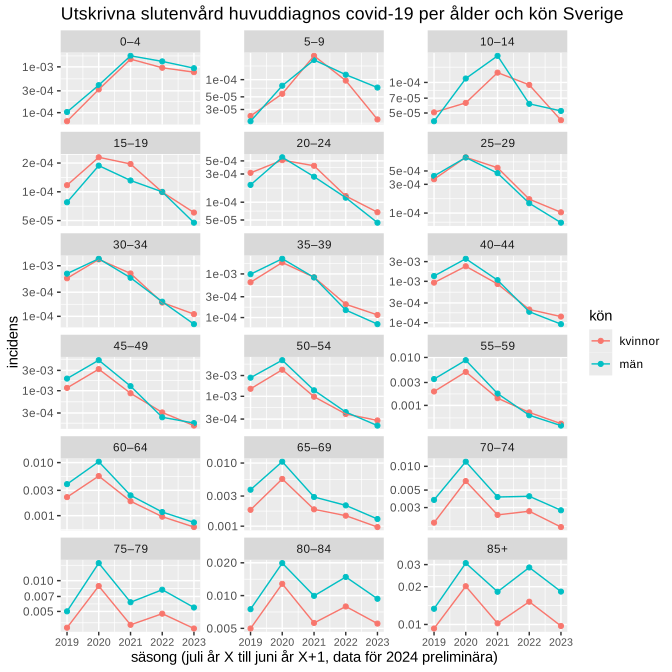
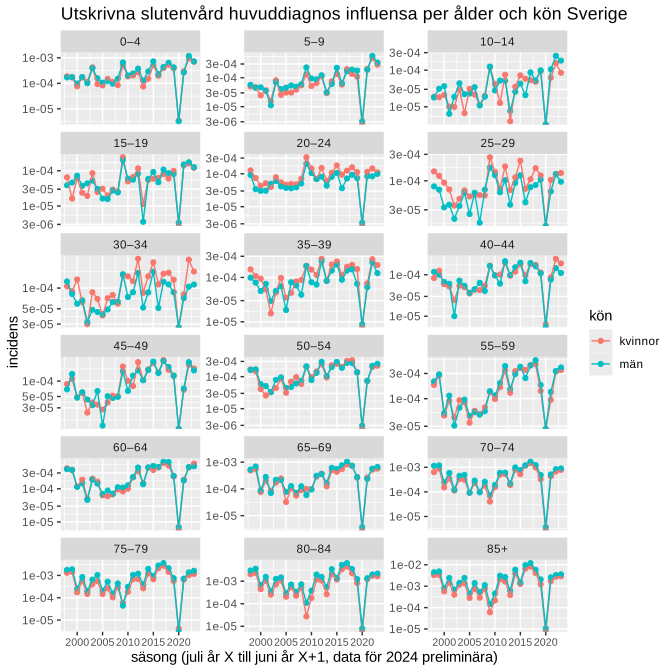
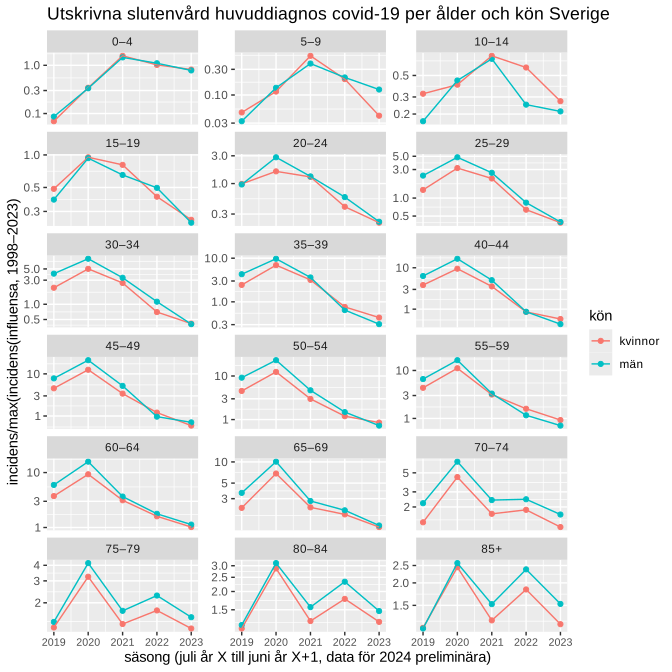
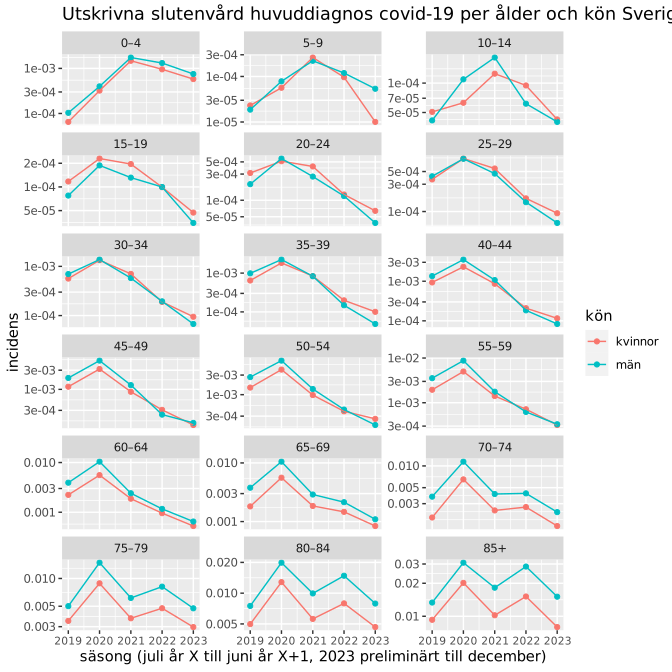
<p>Som i det inlägget visar fig. 1 utskrivna från slutenvård i förhållande
till folkmängden för covid-19 (ICD-10 U07–U09) som huvuddiagnos bland
kvinnor och män i 5-åriga åldersintervall, baserat på data från <span class="citation" data-cites="sossltv">Socialstyrelsen (2024)</span>
och <span class="citation" data-cites="scbregbef">SCB (2024)</span>, över varje säsong (från juli ett år till juni följande
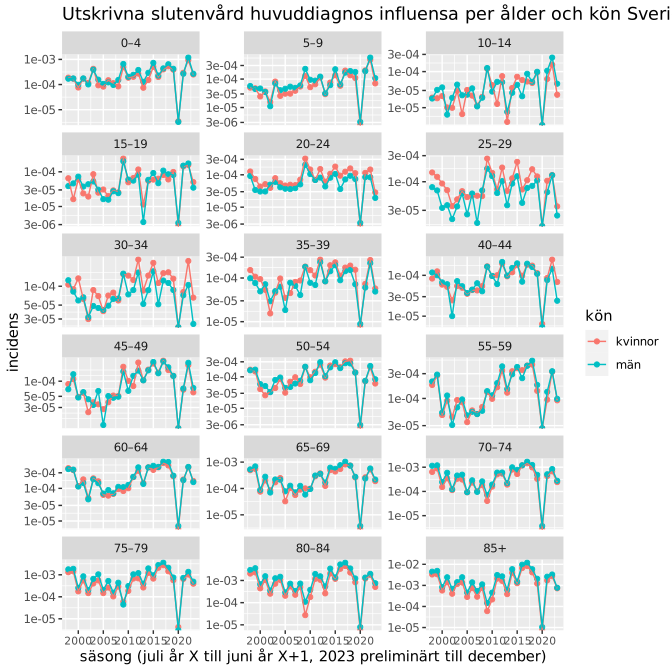
år) då covid-19 cirkulerat. Fig. 2 visar motsvarande incidens för
influensa (ICD-10 J09–J11) tillbaka till 1998, då statistiken för
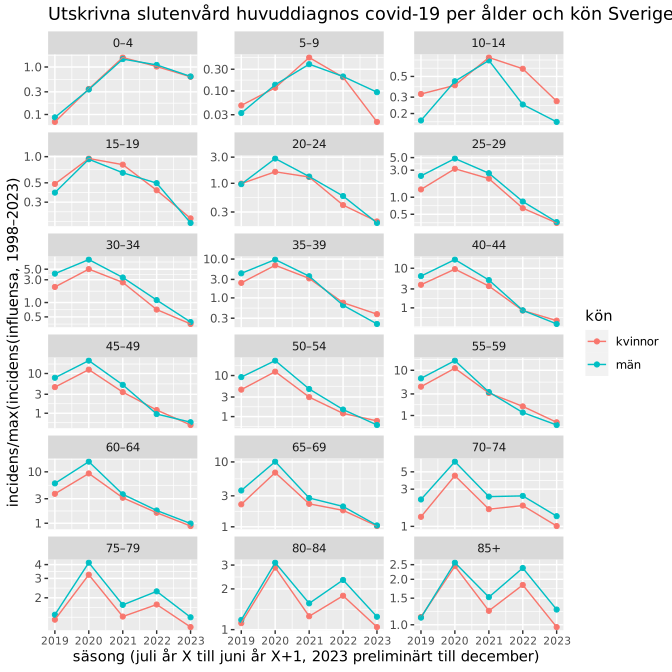
slutenvård börjar. Fig. 3 visar incidens i covid-19 relativt högsta
incidens i influensa för någon säsong under perioden.<a href="#fn1" class="footnote-ref" id="fnref1" role="doc-noteref"><sup>1</sup></a></p>
<figure id="fig:covpop">
<img src="../../images/covpop_2019-2023.svg" style="width:100.0%" alt="Figur 1: Utskrivna från slutenvård covid-19 per ålder och kön Sverige." />
<figcaption aria-hidden="true">Figur 1: Utskrivna från slutenvård covid-19 per ålder och kön
Sverige.</figcaption>
</figure>
<figure id="fig:inflpop">
<img src="../../images/inflpop_1998-2023.svg" style="width:100.0%" alt="Figur 2: Utskrivna från slutenvård influensa per ålder och kön Sverige." />
<figcaption aria-hidden="true">Figur 2: Utskrivna från slutenvård influensa per ålder och kön
Sverige.</figcaption>
</figure>
<figure id="fig:covnorm">
<img src="../../images/covnorm_2019-2023.svg" style="width:100.0%" alt="Figur 3: Utskrivna från slutenvård covid-19 relativt högsta incidens för influensa per ålder och kön Sverige." />
<figcaption aria-hidden="true">Figur 3: Utskrivna från slutenvård covid-19 relativt högsta incidens
för influensa per ålder och kön
Sverige.</figcaption>
</figure>
<p>Som väntat, sett till att covidfallen toppade före nyår, syns inga
dramatiska förändringar av covidkurvan. För alla åldersgrupper var
andelen sjukhusvårdade lägre 2023/24 än 2022/23, och för åldersgrupperna
från 15–19 till 70–74 år var det också den lägsta säsongen under hela
den tid SARS-CoV-2 cirkulerat. Överrisken för män när det gäller
sjukhusvård har försvunnit i åldersgrupperna under 60 år, men finns kvar
i äldre åldersgrupper och är störst bland de äldsta.</p>
<p>Kurvorna för influensa för säsongen 2023/24 har förskjutits uppåt,
vilket också är väntat, då en stor andel av fallen rapporterades efter
nyår. Säsongen som helhet ter sig fortfarande helt ordinär jämfört med
prepandemiska influensasäsonger.</p>
<p>Vad kan vi vänta oss av den kommande vintern? Under sommaren och hösten
har det varit, för säsongen, relativt mycket spridning av SARS-CoV-2,
med ett mönster som litet liknar den sega platå vi såg 2022, och som jag
diskuterade <a href="2023-03-18-platt.html">den 18 mars 2023</a>. De senaste
veckorna har det dock varit en långsam minskning av rapporterade fall,
som inte setts under oktober och november något tidigare år sedan
pandemin började <span class="citation" data-cites="fohmcovfall">(Folkhälsomyndigheten 2024)</span>. <span class="citation" data-cites="kulluftv4724">Karolinska Universitetslaboratoriet (2024)</span> visar på minskning även
för vecka 47. Som visas av <span class="citation" data-cites="covcountry">Hodcroft (2024)</span> har påtagliga skiften när det
gäller varianter av SARS-CoV-2, som ökat virusets förmåga att undkomma
befolkningens immunitet mot smittsam infektion, blivit mer sällsynta
jämfört med den första tiden efter introduktionen av omikron 2021. Sedan
våren 2022 har det i stort sett enbart varit subvarianter av BA.2 som
cirkulerat. Under andra halvåret 2022 dominerade BA.5 och dess avkomling
BQ.1, men den kommande vintern tog XBB, en rekombination av två andra
subvarianter på BA.2-trädet, över scenen, för att dominera under större
delen av 2023, med nya subvarianter och rekombinationer. I mitten av
året kom BA.2.86, som är ytterligare en subvariant av BA.2, utan närmare
släktskap med de ovannämnda, och den blev i Sverige dominerande mot
slutet av året. Den har fortsatt att utvecklas under 2024, men inga nya
skiften till avlägsna subvarianter har observerats. Vi har troligen nu
ganska omfattande immunitet mot BA.2.86 i befolkningen, och därmed
verkar det sannolikt att den kommande vintern blir än lugnare än den
förra när det gäller covid-19.</p>
<p>Influensan har inte tagit fart så långt vi kan observera, även om den
senaste veckans kyla kan komma att visa sig i ökat antal fall framöver.
Sedan influensan återkom efter uppehållet under pandemin har alla tre
varianterna, A(H1N1)pdm09, A(H3N2) och B/Victoria, hunnit cirkulera och
dominera i omgångar, vilket innebär att vi troligen har ett ganska gott
immunitetsläge även här. B/Yamagata tros av många ha försvunnit 2020,
vilket kan hänga samman med att den cirkulerade på låga nivåer redan
innan de pandemirelaterade kontaktminskningarna började, även om det för
några veckor sedan rapporterades ett fall från Nederländerna, vars
status fortfarande är oklar <span class="citation" data-cites="ecdcthreat4324">(ECDC 2024)</span>. I övrigt har diskussionen
kring influensa den senaste tiden varit fokuserad på pandemihotet från
A(H5N1).</p>
<p>Något som fått en hel del uppmärksamhet i media under hösten är
luftvägsinfektioner orsakade av <em>Mycoplasma pneumoniae</em>. Av
<span class="citation" data-cites="kulluftv4724">Karolinska Universitetslaboratoriet (2024)</span> framgår att de rapporterat fallen ökat kraftigt sedan i
somras, efter att smittan varit borta under pandemiåren, börjat komma
tillbaka till sommaren 2023 och sedan i stort sett legat på en platå
över vintersäsongen 2023/24. Möjligen kan den nu ha kulminerat.
Infektionen är inte anmälningspliktig, och det finns ingen rikstäckande
statistik publicerad. Studier av sjukhusinläggningar till följd av
<em>M. pneumoniae</em> med hjälp av statistik publicerad via <span class="citation" data-cites="sossltv">Socialstyrelsen (2024)</span> försvåras
också av att dessa enbart redovisar ICD-koder för huvuddiagnos på
tredjepositionsnivå, samtidigt som lunginflammation orsakad av
<em>M. pneumoniae</em> är en fjärdepositionskod i ICD-10 (J15.7). Det verkar
dock troligt att reducerad immunitet till följd av att smittan hållits
nere under pandemin bidragit till ökad spridning det senaste året. En
liknande ovanlig ökning av infektionen observerades under 2011, vilket
jag skrev om <a href="https://diversepedanteri.blogspot.com/2012/11/en-ny-kandidat.html">den 1 november
2012</a>.
Kanske kan även de relativt små förändringar i kontaktmönster som ägde
rum under pandemin 2009 ha varit en bidragande faktor som rubbade dess
normala mönster. Om det dessutom är så att den, till skillnad från många
virus, sprids lättast under sommar och tidig höst, skulle det möjligen
kunna förklara varför den inte tog fart redan förra vintern.</p>
<h2 class="unnumbered" id="referenser">Referenser</h2>
<div id="refs" class="references csl-bib-body hanging-indent" data-entry-spacing="0" role="list">
<div id="ref-ecdcthreat4324" class="csl-entry" role="listitem">
ECDC. 2024. <span>”Weekly Communicable Disease Threats Report, Week 43, 19–25 October 2024”</span>. <a href="https://www.ecdc.europa.eu/sites/default/files/documents/communicable-disease-threats-report-week-43-2024_corrected.pdf">https://www.ecdc.europa.eu/sites/default/files/documents/communicable-disease-threats-report-week-43-2024_corrected.pdf</a>.
</div>
<div id="ref-fohmcovfall" class="csl-entry" role="listitem">
Folkhälsomyndigheten. 2024. <span>”Bekräftade fall av covid-19 i Sverige”</span>. <a href="https://www.folkhalsomyndigheten.se/faktablad/fall-covid-19/">https://www.folkhalsomyndigheten.se/faktablad/fall-covid-19/</a>.
</div>
<div id="ref-covcountry" class="csl-entry" role="listitem">
Hodcroft, Emma B. 2024. <span>”CoVariants: Per country”</span>. <a href="https://covariants.org/per-country">https://covariants.org/per-country</a>.
</div>
<div id="ref-kulluftv4724" class="csl-entry" role="listitem">
Karolinska Universitetslaboratoriet. 2024. <span>”Luftvägspatogener: Prov analyserade av Karolinska Universitetslaboratoriet till och med vecka 47 2024”</span>. <a href="https://www.karolinska.se/4ad7d7/globalassets/global/2-funktioner/funktion-kul/klinisk-mikrobiologi/epidemiologi/rapport-influensa--och-rs-virus-och-andra-luftvagspatogener.pdf">https://www.karolinska.se/4ad7d7/globalassets/global/2-funktioner/funktion-kul/klinisk-mikrobiologi/epidemiologi/rapport-influensa--och-rs-virus-och-andra-luftvagspatogener.pdf</a>.
</div>
<div id="ref-scbregbef" class="csl-entry" role="listitem">
SCB. 2024. <span>”Folkmängden efter region, civilstånd, ålder och kön”</span>. <a href="https://www.statistikdatabasen.scb.se/goto/sv/ssd/BefolkningNy">https://www.statistikdatabasen.scb.se/goto/sv/ssd/BefolkningNy</a>.
</div>
<div id="ref-sossltv" class="csl-entry" role="listitem">
Socialstyrelsen. 2024. <span>”Statistikdatabas för diagnoser i sluten vård”</span>. <a href="https://sdb.socialstyrelsen.se/if_par/val.aspx">https://sdb.socialstyrelsen.se/if_par/val.aspx</a>.
</div>
</div>
<section id="footnotes" class="footnotes footnotes-end-of-document" role="doc-endnotes">
<hr />
<ol>
<li id="fn1"><p>Figurerna kan återskaps med R genom att klona
<a href="https://github.com/klpn/static-dust.git">bloggförrådet</a> och köra
<code>covnorm.r</code> i underkatalogen <code>postdata/2024-11-25-vag</code>.<a href="#fnref1" class="footnote-back" role="doc-backlink">↩︎</a></p></li>
</ol>
</section>


]]></summary>
</entry>
<entry>
    <title>Börda i öst och väst</title>
    <link href="https://www.dusty-test.klpn.se/posts/2024-05-26-ost.html" />
    <id>https://www.dusty-test.klpn.se/posts/2024-05-26-ost.html</id>
    <published>2024-05-26T00:00:00Z</published>
    <updated>2024-05-26T00:00:00Z</updated>
    <summary type="html"><![CDATA[<h1>Börda i öst och väst</h1>
<div class="info">
	Postad 2024-05-26
	
	av Karl Pettersson.
        
	
	Taggar: <a title="All pages tagged &#39;epidemiologi&#39;." href="/tags/epidemiologi.html" rel="tag">epidemiologi</a>
        
</div>

<p>För någon vecka sedan lanserade IHME en uppdaterad version av Global
Burden of Disease (GBD), med modeller av trender för sjukdomsbörda som
sträcker sig till 2021 <span class="citation" data-cites="ihmegbd">(IHME 2024a)</span>. Detta innebär att år med covid-19 nu
för första gången finns med.</p>
<p>Liksom tidigare rör det sig om komplex modellering, där länders
officiella statistik över dödsorsaker och annat, i de fall där sådan
finns, kombineras med data från undersökningar av förekomsten av
sjukdomar och riskfaktorer<a href="#fn1" class="footnote-ref" id="fnref1" role="doc-noteref"><sup>1</sup></a> och studier av riskfaktorernas effekt på
olika sjukdomar och skador. På så sätt går det att modellera exempelvis
hur många dödsfall, och även partiellt förlorade levnadsår (DALY), som
orsakas av alkohol, som jag skrev om <a href="2022-07-18-grov.html">den 18 juli
2022</a>,</p>
<p>I det inlägget visade jag på hur andelen dödsfall som tillskrivs
cirkulationssjukdom varierar kraftigt mellan olika befolkningar, även
med likartad förväntad livslängd, och att det i sin tur kan påverka
dödsfall och DALY som tillskrivs alkohol och andra riskfaktorer. Jag
utgick då från ländernas officiella statistik, som bara finns
tillgänglig för ett begränsat antal länder, till stor del hög- och
medelinkomstländer.</p>
<p>Fig. 1 och fig. 2 nedan visar förväntad livslängd vid födseln jämfört
med andelen dödsfall i tumörer och sjukdomar i cirkulationsorgan 2019
(det sista år då detta inte påverkades av covid-19) bland män och
kvinnor för alla åldersgrupper och för alla länder och territorier som
ingår i GBD, med ISO 3166-koder färglagda enligt superregion i GBD. Data
över livslängd kommer från <span class="citation" data-cites="hmd">University of California, Berkeley och Max Planck Institute for Demographic Research (2022)</span> och <span class="citation" data-cites="wpp2022">UN Population Division (2022)</span>, och data över andel
dödsfall kommer från <span class="citation" data-cites="gbdresults21">IHME (2024b)</span>.<a href="#fn2" class="footnote-ref" id="fnref2" role="doc-noteref"><sup>2</sup></a></p>
<figure id="fig:ihme21_e0_tum_2019">
<img src="../images/ihme21_e0_tum_2019.svg" style="width:100.0%" alt="Figur 1: Förväntad livslängd vs döda tumörer/alla orsaker 2019 IHME GBD." />
<figcaption aria-hidden="true">Figur 1: Förväntad livslängd vs döda tumörer/alla orsaker 2019 IHME
GBD.</figcaption>
</figure>
<figure id="fig:ihme21_e0_circ_2019">
<img src="../images/ihme21_e0_circ_2019.svg" style="width:100.0%" alt="Figur 2: Förväntad livslängd vs döda cirkulationsorgan/alla orsaker 2019 IHME GBD." />
<figcaption aria-hidden="true">Figur 2: Förväntad livslängd vs döda cirkulationsorgan/alla orsaker
2019 IHME
GBD.</figcaption>
</figure>
<p>För det första kan ses att andelen för båda orsaksgrupperna är låg i
länder med livslängd under 65 år, vilket är väntat, eftersom en stor
andel av dessa befolkningar dör tidigt av tuberkulos, magtarminfekioner,
neonatala tillstånd och annat. Men i övrigt skiljer sig mönstret för
tumörer från mönstret för cirkulationssjukdom på vissa tydliga sätt.
Andelen dödsfall i tumörer är relativt förutsägbar utifrån livslängden,
speciellt bland kvinnor, även om det finns några befolkningar med
avvikande mönster. Befolkningar med likartad livslängd har ungefär samma
andel oavsett vilken superregion de tillhör. Så är inte fallet med
cirkulationssjukdom. För befolkningar där kvinnorna har livslängd i
spannet 75–80 år<a href="#fn3" class="footnote-ref" id="fnref3" role="doc-noteref"><sup>3</sup></a> är variationsområdet över 50 procentenheter.
Variationen hänger tydligt samman med vilken region befolkningarna
tillhör, så att andelen är låg i Latinamerika och hög i forna
östblocket.</p>
<p>Höginkomstländer (alltså Västeuropa inklusive länder som Cypern och
Israel, Nordamerika, Australien Nya Zeeland och vissa asiatiska länder,
som Japan och Sydkorea) har numera i regel en livslängd på över 80 år
bland kvinnor och ofta även bland män. Även bland dessa varierar andelen
cirkulationsdödsfall kraftigt och har inget tydligt samband med
livslängden, samtidigt som andelen generellt är lägre än i östländerna.
Utifrån detta kan det te sig rimligt att anta att det finns betydande
regionala variationer i sättet att rapportera dödsorsaker, och att dessa
inte kompenseras, utan kanske ibland förstärks, genom IHME:s
modelleringar.</p>
<p>Dessa observationer kan också kasta nytt ljus över de <q>paradoxer</q>
relaterade till cirkulationsdödlighet som noterades i slutet av
1900-talet <span class="citation" data-cites="grimes00">(Grimes 2000)</span>. Den mest kända är troligen den <q>franska
paradoxen</q>, med Frankrikes låga kranskärlsdödlighet trots relativt
ogynnsamma nivåer av riskfaktorer som kolesterol och rökning, vilket
ofta använts för att argumentera för nyttan med alkohol, och speciellt
rödvin. Samtidigt har livslängden i Frankrike inte varit exceptionell
jämfört med andra höginkomstländer, även om Grimes kontrasterar regioner
i Frankrike med låg total mortalitet (Toulouse) mot regioner i
Storbritannien med hög mortalitet (Belfast), då dessa ingick i WHO:s
MONICA-studie. Det finns också den <q>albanska paradoxen</q>, med hög
livslängd trots fattigdom och den <q>israeliska paradoxen</q>, med relativt
höga nivåer av ohälsa trots vad som antas vara bra matvanor
<span class="citation" data-cites="Shapira2007">(Shapira 2007)</span>. Det vi nu kan se är en litet annan typ av <q>paradoxalt
mönster</q>. Länder som Albanien ligger fotfarande högt livslängdsmässigt
jämfört med de flesta andra gamla östländer. När det gäller kvinnornas
livslängd hamnar Albanien och Estland nära höginkomstländer som Danmark
och Israel, samtidigt som andelen cirkulationsdödsfall i de förra
länderna enligt GBD överstiger andelen i de senare länderna med 30–40
procentenheter.</p>
<h2 class="unnumbered" id="referenser">Referenser</h2>
<div id="refs" class="references csl-bib-body hanging-indent" data-entry-spacing="0" role="list">
<div id="ref-grimes00" class="csl-entry" role="listitem">
Grimes, D. S. 2000. <span>”Respiratory infection and coronary heart disease: progression of a paradigm”</span>. <em>QJM</em> 93. doi:<a href="https://doi.org/10.1093/qjmed/93.6.375">10.1093/qjmed/93.6.375</a>.
</div>
<div id="ref-ihmegbd" class="csl-entry" role="listitem">
IHME. 2024a. <span>”<span>Global Burden of Disease</span>”</span>. <a href="https://www.healthdata.org/research-analysis/gbd">https://www.healthdata.org/research-analysis/gbd</a>.
</div>
<div id="ref-gbdresults21" class="csl-entry" role="listitem">
———. 2024b. <span>”<span>Global Burden of Disease Study 2021 (GBD 2021) Results</span>”</span>. <a href="http://ghdx.healthdata.org/gbd-results-tool">http://ghdx.healthdata.org/gbd-results-tool</a>.
</div>
<div id="ref-Shapira2007" class="csl-entry" role="listitem">
Shapira, Niva. 2007. <span>”Israeli ’cancer shift’ over heart disease mortality may be led by greater risk in women with high intake of n-6 fatty acids”</span>. <em>European Journal of Cancer Prevention</em> 16 (5). doi:<a href="https://doi.org/10.1097/CEJ.0b013e3280145b6d">10.1097/CEJ.0b013e3280145b6d</a>.
</div>
<div id="ref-wpp2022" class="csl-entry" role="listitem">
UN Population Division. 2022. <span>”World Population Prospects 2022”</span>. <a href="https://population.un.org/wpp/Download/Standard/Mortality/">https://population.un.org/wpp/Download/Standard/Mortality/</a>.
</div>
<div id="ref-hmd" class="csl-entry" role="listitem">
University of California, Berkeley och Max Planck Institute for Demographic Research. 2022. <span>”<span>Human Mortality Database</span>”</span>. <a href="https://www.mortality.org">https://www.mortality.org</a>.
</div>
</div>
<section id="footnotes" class="footnotes footnotes-end-of-document" role="doc-endnotes">
<hr />
<ol>
<li id="fn1"><p>När det gäller mat-, rök- och alkoholvanor, exponeringar i
yrkeslivet, föroreningar, fysiologiska variabler som BMI och
blodtryck, orent vatten, utsatthet för våld och så vidare.<a href="#fnref1" class="footnote-back" role="doc-backlink">↩︎</a></p></li>
<li id="fn2"><p>Figurerna kan återskapas med R genom att klona
<a href="https://github.com/klpn/static-dust.git">bloggförrådet</a> och köra
<code>2024-05-26-ost.r</code> i underkatalogen <code>postdata/2024-05-26-ost</code>.<a href="#fnref2" class="footnote-back" role="doc-backlink">↩︎</a></p></li>
<li id="fn3"><p>Vilket motsvarar utvecklingen i Sverige från 1960- talet till
80-talet: en period då andelen, enligt officiell statistik, låg i
stort sett oförändrad på strax över 50 procent, som kan ses i mitt
inlägg <a href="2022-03-27-transition.html">den 27 mars 2022</a>.<a href="#fnref3" class="footnote-back" role="doc-backlink">↩︎</a></p></li>
</ol>
</section>


]]></summary>
</entry>
<entry>
    <title>Postpandemisk påsk</title>
    <link href="https://www.dusty-test.klpn.se/posts/2024-03-31-post.html" />
    <id>https://www.dusty-test.klpn.se/posts/2024-03-31-post.html</id>
    <published>2024-03-31T00:00:00Z</published>
    <updated>2024-03-31T00:00:00Z</updated>
    <summary type="html"><![CDATA[<h1>Postpandemisk påsk</h1>
<div class="info">
	Postad 2024-03-31
	
	av Karl Pettersson.
        
	
	Taggar: <a title="All pages tagged &#39;epidemiologi&#39;." href="/tags/epidemiologi.html" rel="tag">epidemiologi</a>
        
</div>

<p>Den 22 mars publicerade SCB livslängdstabeller för Sverige 2023
<span class="citation" data-cites="scblt">(SCB 2024a)</span>. Den förväntade livslängden vid födseln 2023 är 84,9 år för
kvinnor och 81,58 år för män. Det innebär att 2023 är det första året
med högre förväntad livslängd än 2019 både bland kvinnor och män. Det
var förstås pandemin med covid-19 som orsakade tillbakagången 2020, och
efter det har livslängden åter ökat stadigt bland män, samtidigt som den
2022 gick tillbaka något bland kvinnor, vilket till stor del har att
göra med dynamiken i hur covid-19 drabbade olika åldersgrupper under
olika faser av pandemin, som jag skrev om <a href="2023-02-26-2019.html">den 26 februari förra
året</a>.</p>
<p>Det är klart att covid-19 fortfarande ger upphov till viss mortalitet,
så att livslängden 2023 skulle ha varit ännu något högre om smittan inte
spritts, samtidigt som ökad immunitet i befolkningen, genom både vaccin
och infektioner gör att mortaliteten är mycket lägre än den varit
tidigare, trots att det 2023 knappast varit några kontaktreduktioner för
att begränsa smittspridningen hos befolkningen i stort.</p>
<p>En annan aspekt av covid-19 är den kraftiga belastning på sjukvården som
uppstod, då även många relativt unga personer blev svårt sjuka och
behövde vård, och i en del fall intensivvård, på sjukhus. Redan tidigt
under pandemin förutsåg många att covid-19 även i detta avseende efter
hand skulle dämpas med ökande immunitet, och inte längre vara något
exceptionellt i jämförelse med andra luftvägssmittor, som influensa och
de tidigare etablerade säsongscoronavirusen.</p>
<p>Fig. 1 visar utskrivna från slutenvård i förhållande till folkmängden
för covid-19 (ICD-10 U07–U09) som huvuddiagnos bland kvinnor och män i
5-åriga åldersintervall, baserat på data från <span class="citation" data-cites="sossltv">Socialstyrelsen (2024)</span> och <span class="citation" data-cites="scbregbef">SCB (2024b)</span>,
över varje säsong (från juli ett år till juni följande år) då covid-19
cirkulerat. Fig. 2 visar motsvarande incidens för influensa (ICD-10
J09–J11) tillbaka till 1998, då statistiken för slutenvård börjar.
Fig. 3 visar incidens i covid-19 relativt högsta incidens i influensa
för någon säsong under perioden. Observera att statistiken för säsongen
2023/24 är preliminär: dels kan statistiken för kalenderåret 2023
justeras uppåt, dels kommer den förstås att utökas med utskrivna under
första halvåret 2024. Dock tyder den relativt låga incidensen i covid-19
efter nyår <span class="citation" data-cites="fohmcovfall">(Folkhälsomyndigheten 2024)</span> på att detta inte kommer att medföra något
trendbrott i förhållande till vad som nu kan observeras.<a href="#fn1" class="footnote-ref" id="fnref1" role="doc-noteref"><sup>1</sup></a></p>
<figure id="fig:covpop">
<img src="../../images/covpop.svg" style="width:100.0%" alt="Figur 1: Utskrivna från slutenvård covid-19 per ålder och kön Sverige." />
<figcaption aria-hidden="true">Figur 1: Utskrivna från slutenvård covid-19 per ålder och kön
Sverige.</figcaption>
</figure>
<figure id="fig:inflpop">
<img src="../../images/inflpop.svg" style="width:100.0%" alt="Figur 2: Utskrivna från slutenvård influensa per ålder och kön Sverige." />
<figcaption aria-hidden="true">Figur 2: Utskrivna från slutenvård influensa per ålder och kön
Sverige.</figcaption>
</figure>
<figure id="fig:covnorm">
<img src="../../images/covnorm.svg" style="width:100.0%" alt="Figur 3: Utskrivna från slutenvård covid-19 relativt högsta incidens för influensa per ålder och kön Sverige." />
<figcaption aria-hidden="true">Figur 3: Utskrivna från slutenvård covid-19 relativt högsta incidens
för influensa per ålder och kön
Sverige.</figcaption>
</figure>
<p>Barn under 15 år hade generellt högst incidens i sjukhusvård för
covid-19 under säsongen 2021/22. Under denna period kom omikron, då en
stor andel av befolkningen, i alla åldersgrupper, smittades på kort tid
och få barn hade vaccinerats. Bland barn 5–14 år har dock incidensen
hela tiden varit betydligt lägre än under de högsta influensasäsongerna.
Bland ungdomar och unga vuxna 15–24 år var säsongerna 2020/21 och
2021/22 ganska likartade och i nivå med de högsta influensasäsongerna,
även om säsongen 2020/21 var högre bland män 20–24. Kvinnor har också
generellt haft något högre incidens än män i dessa åldersgrupper, både
för covid-19 och influensa. Då statistiken gäller huvuddiagnos kan det
knappast förklaras av kvinnor som testat positivt i mödravården utan att
i övrigt vara i behov av vård för infektionen.</p>
<p>Bland medelålders sågs tidigt under pandemin ett mönster med manlig
överrisk för vårdkrävande covid-19, vilket diskuterades en hel del då,
som jag skrev en del om, t.ex. <a href="2020-04-25-brant.html">den 25 april
2020</a>. Det är dock också bland medelålders män
som det går att se den mest dramatiska nedgångden i sjukhusvård efter
att immuniteten byggts upp. Män i 50-årsåldern har gått från ha uppåt 30
gånger så hög incidens som under de högsta influensasäsongerna till att
hamna under dessa, och könsskillnaden i gruppen har också minskat, både
i absoluta och relativa tal.</p>
<p>De högsta åldersgrupperna har inte haft lika förhöjd incidens relativt
influensa som de medelålders, men å andra sidan har det inte skett samma
snabba nedgång i dessa grupper. I åldersgrupperna över 75 år var
incidensen signifikant högre 2022/23 än under 2021/22, vilket kan hänga
samman med en återgång till prepandemiska kontaktmönster även bland de
äldre.</p>
<p>Den generella bilden är att barn och unga hanterat covid-19 på ett sätt
som inte är olikt andra för dem nya luftvägsvirus de utsätts för. För
medelålders, som annars sällan utsätts för helt nya virus, kan
primärinfektioner utan föregående vaccinering vara riskabla, men
samtidigt kan den gruppen relativt lätt bilda robust immunitet mot svår
sjukdom. När det gäller de äldre talar mycket för att vi kommer att se
hög sjukdomsbörda och behov av boosterdoser under lång tid framöver, på
liknande sätt som med influensa A(H3N2), som cirkulerat sedan 1968 och
där dagens äldre alltså inte heller exponerats i unga år.</p>
<h2 class="unnumbered" id="referenser">Referenser</h2>
<div id="refs" class="references csl-bib-body hanging-indent" data-entry-spacing="0" role="list">
<div id="ref-fohmcovfall" class="csl-entry" role="listitem">
Folkhälsomyndigheten. 2024. <span>”Bekräftade fall av covid-19 i Sverige”</span>. <a href="https://www.folkhalsomyndigheten.se/faktablad/fall-covid-19/">https://www.folkhalsomyndigheten.se/faktablad/fall-covid-19/</a>.
</div>
<div id="ref-scbregbef" class="csl-entry" role="listitem">
SCB. 2024b. <span>”Folkmängden efter region, civilstånd, ålder och kön”</span>. <a href="https://www.statistikdatabasen.scb.se/goto/sv/ssd/BefolkningNy">https://www.statistikdatabasen.scb.se/goto/sv/ssd/BefolkningNy</a>.
</div>
<div id="ref-scblt" class="csl-entry" role="listitem">
———. 2024a. <span>”Ettårig livslängdstabell för hela riket efter kön och ålder”</span>. <a href="https://www.statistikdatabasen.scb.se/goto/sv/ssd/LivslangdEttariga">https://www.statistikdatabasen.scb.se/goto/sv/ssd/LivslangdEttariga</a>.
</div>
<div id="ref-sossltv" class="csl-entry" role="listitem">
Socialstyrelsen. 2024. <span>”Statistikdatabas för diagnoser i sluten vård”</span>. <a href="https://sdb.socialstyrelsen.se/if_par/val.aspx">https://sdb.socialstyrelsen.se/if_par/val.aspx</a>.
</div>
</div>
<section id="footnotes" class="footnotes footnotes-end-of-document" role="doc-endnotes">
<hr />
<ol>
<li id="fn1"><p>Figurerna kan återskaps med R genom att klona
<a href="https://github.com/klpn/static-dust.git">bloggförrådet</a> och köra
<code>covnorm.r</code> i underkatalogen <code>postdata/2024-03-31-post</code>.<a href="#fnref1" class="footnote-back" role="doc-backlink">↩︎</a></p></li>
</ol>
</section>


]]></summary>
</entry>

</feed>